Three-Agency Plan Targets Chronic Waterlogging at Bajghera Underpass
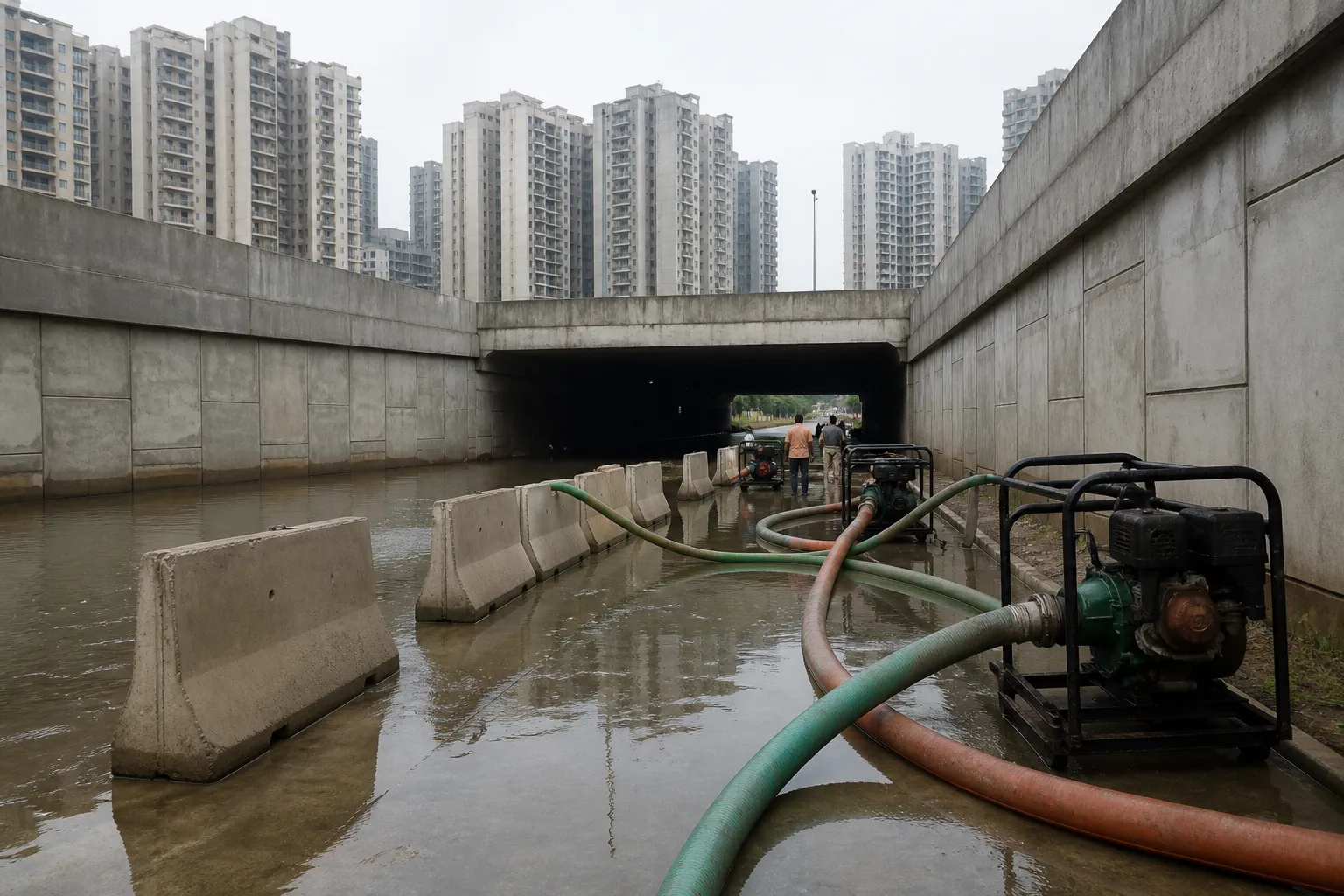
GURUGRAM: Three public agencies have divided responsibility for a permanent drainage response at Bajghera underpass after heavy rain once again forced the Dwarka Expressway link to close. The plan assigns separate work to the National Highways Authority of India, the Gurugram Metropolitan Development Authority and Haryana's Public Works Department.
The underpass flooded after Tuesday evening's rain, interrupting movement between sectors around Bajghera Road and the expressway. A joint inspection followed on Wednesday. Officials have now proposed measures to control how much runoff reaches the low point, improve pumping at the underpass and create a route for water to reach the master drain.
NHAI to regulate runoff at approaches
NHAI has been asked to construct table-top barriers on the approach roads. These raised sections are intended to slow or redirect stormwater before it rushes down towards the underpass. The precise design and construction timeline have not been publicly detailed, so the measure should be treated as planned work rather than a completed defence.
GMDA will inspect the existing sump wells and pumping system at the underpass. Repairs and capacity upgrades are to be taken up where required. This part of the plan addresses water that still reaches the low-lying carriageway despite the approach-road intervention.
Surface drains to connect with Leg-1
PWD's assignment is to build surface drains along Bajghera Road and link them to GMDA's Leg-1 master stormwater drain. That connection is central to the proposal. Pumping water out of an underpass provides only temporary relief if nearby roads have no clear outfall or if the receiving drain is already choked.
GMDA deployed a super-sucker machine to desilt about 300 metres of the Leg-1 drain following the inspection. Officials said the immediate cleaning was intended to improve carrying capacity and stop water spilling back during heavy rain. Desilting is useful maintenance, but it cannot substitute for the proposed missing surface-drain link.
The agencies described the programme as a permanent solution. That is their stated objective, not yet an established result. Its effectiveness will be known only after the civil works are completed and the system is tested under another intense spell of rainfall.
Coordination is the real test
Bajghera underpass has repeatedly exposed the cost of divided ownership. One agency controls the expressway structure, another the master drain and a third the adjoining road. When those parts are planned or maintained separately, runoff naturally follows the lowest contour rather than an administrative boundary.
The new division of work is clearer than another round of emergency pumping, but it needs a shared execution schedule. Residents and commuters should be able to see when the table tops, sump repairs and surface drains will be completed, and which officer is responsible for each milestone.
Until then, traffic restrictions may still be required during intense rain. Barricades and diversion messages should be placed before water reaches unsafe depth, not after vehicles enter the underpass. The immediate desilting may reduce risk, but the larger promise now depends on all three agencies completing their connected pieces of the drainage chain.
Sources and reporting
Original Dalimss News report based on the joint agency plan and verified official statements available on 8 August 2026.
Related Stories
Festive Special to Gorakhpur Gets Gurugram Halt
Fifth Accused Held in Rs 25 Lakh Sector 47 Robbery

Courier Staffer Booked Over 105 Missing One8 Returns
HC Sets Rs 50 Lakh Costs for Accused's Return to India

Gurugram Swimmer, 20, Crosses English Channel