
Supreme Court Panel Surveys Gurugram Aravallis, Flags Mangar Bani Protection Gap
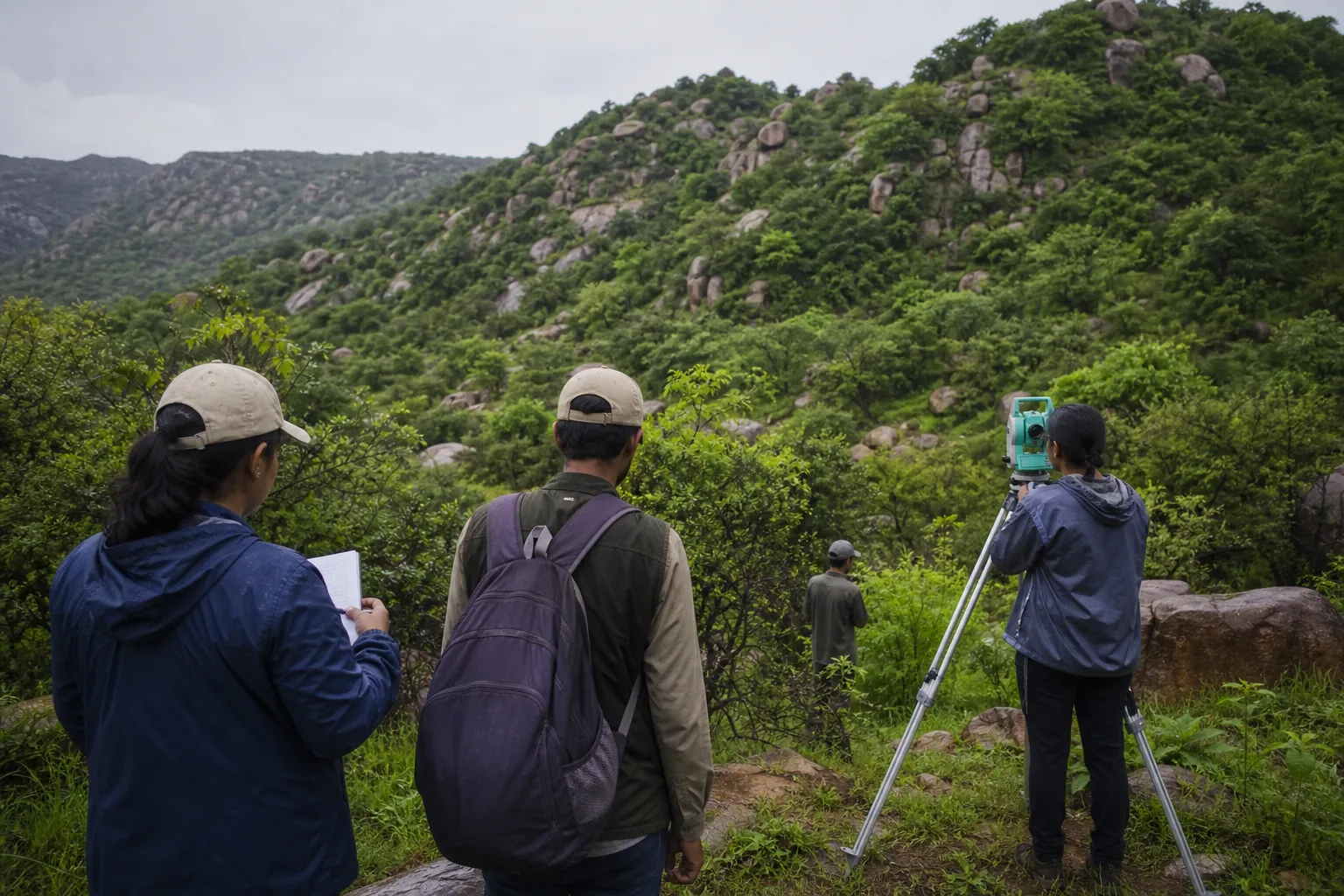
GURUGRAM: A Supreme Court-appointed committee has begun field work that could reshape how the Aravalli range is identified and protected across Haryana, Delhi and Rajasthan. The panel inspected Mangar Bani and Gurugram Nagar Van as part of a multi-state survey and highlighted the gap between Mangar Bani's recognised ecological value and its limited formal statutory protection.
The high-powered committee was constituted under a May 25 court order and has been asked to submit its report by August 31. Its task is not simply to draw a fresh line on a map. It must recommend a scientific and legally sustainable framework for deciding which land forms part of the Aravalli hills and ranges.
Mangar Bani examined beyond tree cover
Committee members spent nearly two hours at Mangar Bani discussing biodiversity, geology, water movement and the sacred grove's ecological role. The patch is widely regarded as one of the most intact forest areas in the northern Aravallis and remains a no-construction zone, yet conservationists have long argued that it needs stronger and clearer legal protection.
The distinction matters because a landscape can provide groundwater recharge, wildlife habitat and flood moderation even when revenue records do not neatly classify every parcel as forest. A definition based only on one historical map or present tree density can miss rocky slopes, scrub and drainage corridors that keep the larger ecosystem functional.
Survey spans law, science and livelihoods
The panel told the state that its assessment would consider ecological, geological, hydrological, biodiversity, mining, land-use and socio-economic factors. That broad scope is necessary because the Aravallis cross administrative boundaries and contain villages, roads, farms, mines, commons and urban development pressures.
Different definitions used over the years have complicated decisions on mining, construction and conservation. A narrow definition may leave connected terrain exposed; an overbroad one without precise criteria can create uncertainty for residents and landowners. The committee's challenge is to make the framework scientifically defensible, legally usable and transparent enough to be applied parcel by parcel.
Gurugram Nagar Van part of first phase
Along with Mangar Bani and Delhi's Asola area, the committee inspected Gurugram Nagar Van before continuing its survey. For Gurugram, the outcome could affect how hill contours, natural drains and forest links are treated as the city expands south and west.
The report should ideally identify the data used, the resolution of maps, the method for field verification and a process for correcting errors. Public access to those elements would reduce future disputes and make it harder for protection to be weakened through inconsistent interpretation.
The August 31 deadline gives the panel little time for a landscape spread across three states. Its visit has nevertheless put a specific question on record: if Mangar Bani is ecologically exceptional, what legal instrument will protect it from piecemeal loss? The answer will matter not only to one grove, but to Gurugram's water security, heat resilience and remaining connection to the Aravalli system.
Sources and reporting
Original Dalimss News report based on the court-mandated survey schedule and verified field-inspection information available on 9 August 2026.
Related Stories

Festive Special to Gorakhpur Gets Gurugram Halt
Fifth Accused Held in Rs 25 Lakh Sector 47 Robbery

Courier Staffer Booked Over 105 Missing One8 Returns

HC Sets Rs 50 Lakh Costs for Accused's Return to India

Gurugram Swimmer, 20, Crosses English Channel