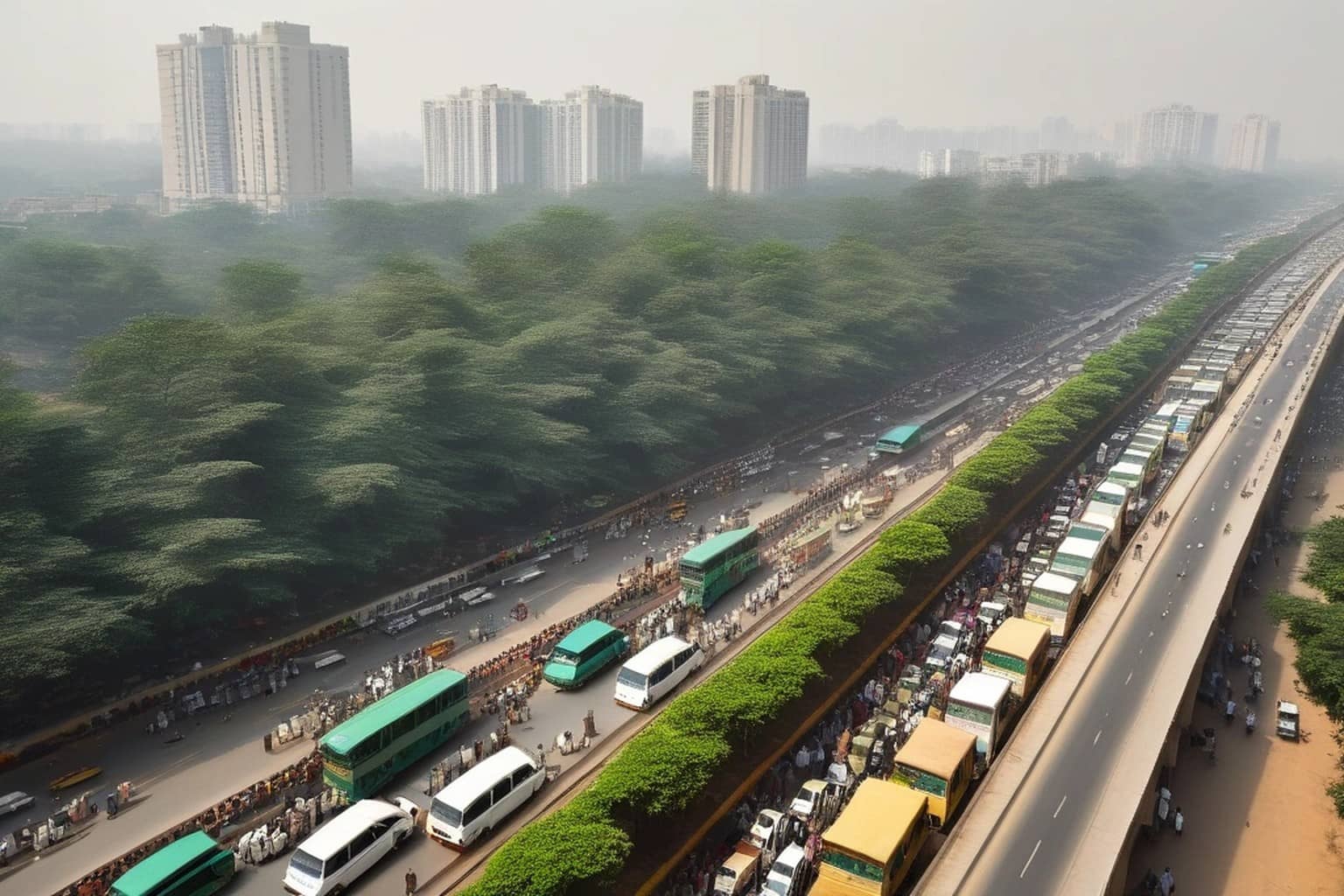
GURUGRAM: A sit-in by teacher-training students outside the State Council of Educational Research and Training (SCERT) office brought Sohna Road to a near standstill on Monday afternoon, with traffic backed up for close to three kilometres and an ambulance stuck in the queue for more than 40 minutes.
The jam spread from the Rajiv Chowk underpass and junction past the Tau Devi Lal Sports Complex towards Civil Lines and the District and Sessions Court. Traffic police said their teams were on the ground throughout and put diversions in place, but it took close to three hours before vehicles were moving normally again.
The protest was not announced in advance. Two-wheeler riders who tried to squeeze through along the footpath edges only added to the blockage, and vehicles caught inside the underpass had no way out until the queue ahead moved.
The students are from the State Institute of Advanced Studies in Teacher Education (SIASTE) in Gurugram, which runs a four-year integrated BA-BEd course. Their problem is that the course has been running without recognition from the National Council for Teacher Education (NCTE), the body that must approve every teacher-education programme in the country.
Without that approval, a BEd degree can be questioned when a graduate applies for a teaching post or for higher study. In a representation to Deputy Commissioner Uttam Singh, the students said nearly 800 of them are affected. They have asked for a written assurance that those who have graduated or cleared exams will not face trouble over qualifications, jobs or any plan to shift them.
What the High Court has said so far
The matter is already before the Punjab and Haryana High Court. In October last year a division bench of Justice Ashwani Kumar Mishra and Justice Rohit Kapoor found a prima facie case of dereliction of duty by Haryana officers who allowed the unauthorised course to start, and said hundreds of students' careers had been put at stake.
The bench recorded then that students were admitted at two new SIASTE centres, in Gurugram and Kurukshetra, even though NCTE permission had not been granted. The Union government told the court the state's application to NCTE, dated 11 July 2020, lacked key details about the institutions. NCTE said there is no provision for granting permission with retrospective effect once a course has started. The court directed the Chief Secretary to hold an inquiry and say who was responsible and how the students would be compensated.
In its order of 29 September this year, the court recorded that NCTE's Northern Regional Committee had given a no-objection to shifting the students on paper to recognised institutions, subject to the seats those institutions are sanctioned for. NCTE told the court that current students would be moved to recognised institutions, and those who have already graduated would be shifted notionally.
The Haryana government, for its part, told the court that degrees already issued by the university will remain valid. The students want that assurance in writing, which is the main demand in their representation to the Deputy Commissioner. The next hearing is on 13 October.
This is not the only teacher-related protest the city has seen recently. Last month government primary teachers in Gurugram took to the streets over the eligibility test rule for older recruits, as Dalimss reported in its story on the primary teachers' protest.
For commuters, Monday showed how little slack the stretch has. Sohna Road, Rajiv Chowk and the roads towards the court and the mini secretariat are among the busiest in the city in the afternoon, and with the underpass feeding straight into the junction, a single blockage near it backs traffic up quickly. A similar knock-on effect was seen when a blocked turn near Shankar Road pushed congestion into Udyog Vihar.
Until the court decides how the shifting will work and what each student's degree will say, around 800 young people who trained to be schoolteachers remain unsure whether their qualification will count.