BENGALURU: In most Indian pathology labs, a blood smear still ends up under a microscope with a technician bent over the eyepiece, counting and sorting cells by hand. It is slow, tiring work, and two people looking at the same slide do not always agree. SigTuple, a Bengaluru company founded in 2015, has spent a decade trying to hand that job to robots and software.
The company now sells three machines: AI100 for blood and urine samples in human labs, AS76 for blood smears with the AI running inside the box, and SigVet for veterinary clinics. Here is what each one does, according to SigTuple's own product pages, and where the claims stand.
The problem it is going after
Microscopy is still treated as the gold standard for diagnosing several serious conditions, from anaemia and infections to blood cancers. SigTuple's argument, set out on its about page, is that the manual process is inconsistent and does not scale, and it cites a figure of one qualified pathologist per million people. That number is the company's, and estimates vary, but the shortage of pathologists outside big cities is a well known gap in Indian healthcare.
SigTuple's answer is to digitise the slide. A machine scans it, software sorts the cells, and a pathologist reviews the results on a screen, possibly from another city. The human still signs the report. The company is careful on this point: its pages describe the AI classification as transparent, backed by images, and overridable by the pathologist.
AI100: the cloud-connected workhorse
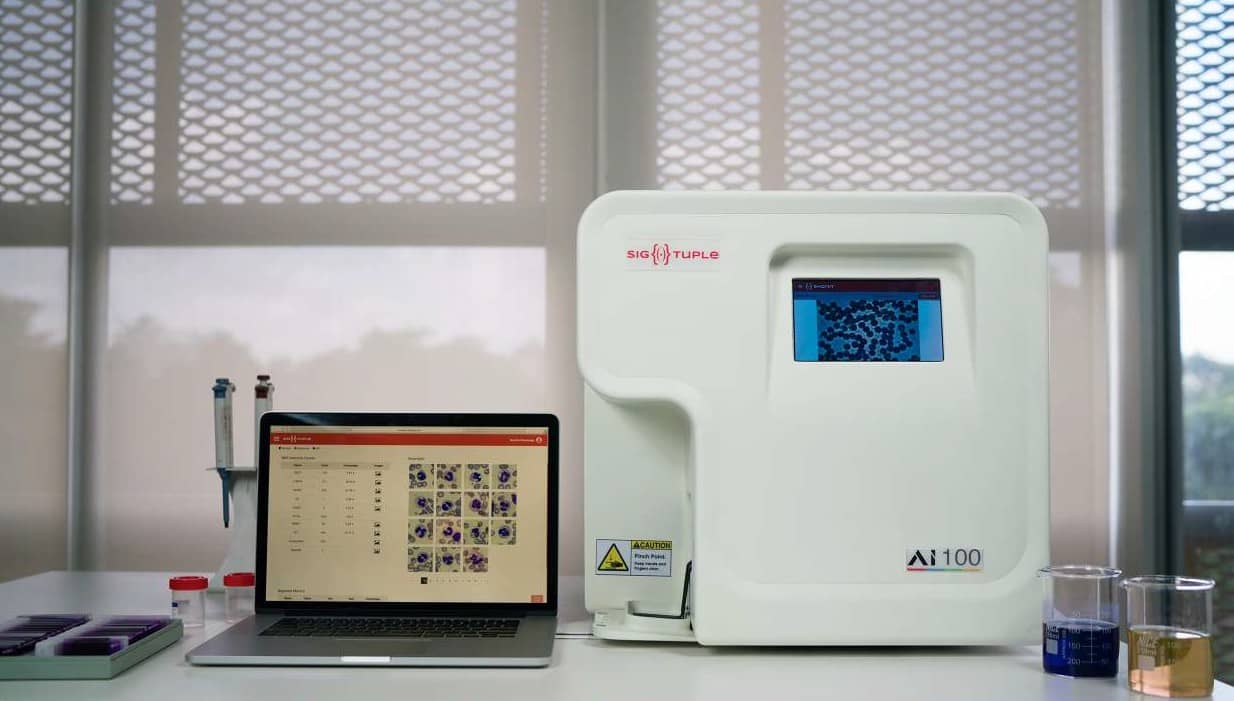
AI100 was launched in 2018, and SigTuple calls it India's first AI-powered automated digital microscope for peripheral blood smear analysis. It is a bench-top in-vitro diagnostic device that uses a motorised stage and a high-resolution camera to scan blood and urine samples on a glass slide.
The product page lists two applications. The blood smear analyser gives a 7-part white blood cell differential, grades red blood cell shape and size, and classifies platelets. The urine sediment analyser looks for red cells, casts, crystals, yeast, epithelial cells, pus cells and organisms. SigTuple says its models classify more than 30 cell types and were trained on millions of annotated cells.
On paper the throughput is 20 or more blood slides an hour and 40 or more urine samples an hour. The AI processing happens in the cloud, and reports open in a web browser, which is what allows a pathologist to review cases from home. SigTuple lists US FDA 510(k) clearance and CE IVDR marking for the blood application and CE IVDR for the urine one. Its timeline puts the FDA clearance in 2023 and describes it as the first integrated hardware and AI device in digital microscopy from India.
The company also lists a 2022 partnership with HORIBA Medical to push AI100 in India, and says Dr Lal PathLabs has deployed AI100 across its network.
AS76: keeping the data inside the lab
The newer AS76, unveiled in 2025, takes a different approach. Instead of sending images to the cloud, it runs the AI on an NVIDIA RTX processor inside the machine. SigTuple says no images leave the lab and the unit works with no internet connection at all, and it pitches the machine at rural hospitals, field labs and military facilities where bandwidth is poor.
That matters in India for two reasons. Connectivity in small-town labs is patchy, and hospitals are increasingly cautious about patient data leaving their premises. An edge device sidesteps both, at the cost of more computing hardware in each unit.
AS76 has an automated turret with 20x, 40x and 100x objectives, takes up to six slides at a time, and dispenses immersion oil and reads barcodes on its own so a technician can load it and walk away. The company says it pre-classifies up to 200 white cells per slide and analyses more than 2,000 red cells, grading them to international haematology guidelines. It says software updates will add new test types over time, naming tissues, body fluids and bone marrow as future modules. None of those are listed as available yet.
SigVet: the same idea for animals
SigVet, launched in 2025, brings the image-based approach to veterinary clinics. It is a compact point-of-care analyser for dogs, cats and horses that runs a complete blood count and reticulocyte analysis from about 30 microlitres of blood in a single-use cartridge. SigTuple lists urine, faecal and cytology tests as upcoming. Veterinary diagnostics in India still leans heavily on sending samples out to reference labs, so an in-clinic option fills a real need if the price works for small practices. The company does not publish prices on its site.
Who runs it and how big it is
The leadership page names Tathagato Rai Dastidar, who holds a PhD in computer science from IIT Kharagpur, as founder and CEO, and Pranat Bhadani, an IIT Bombay graduate, as co-founder and business head. Dr Renu Ethirajan, a pathologist, is chief medical evangelist, and Pavan Chandra Konda heads technology.
By the company's own count it has more than 10 years of R&D, 27 patents, more than 30 publications, over 350 deployments and a presence in seven countries, with recent expansion into the Middle East and Europe. Those figures come from SigTuple and have not been independently verified.
SigTuple is one of several Indian companies applying AI to health checks. Dalimss News has written about Curelink's Disha, an AI health coach from Gurugram, and about the secure data environment announced under the Ayushman Bharat Digital Mission, which shapes how health data can be shared.
What to watch
The open questions are commercial. Lab chains will want to see how the cost per test compares with a human technician, and how often pathologists have to correct the AI's calls in daily use. The tissue and bone marrow modules promised for AS76 would also move the company into harder diagnostic territory, where regulators will look much more closely. For patients, the change is mostly invisible: a faster report, and a pathologist who may be sitting hundreds of kilometres away from the slide.