Queer and Trans Youth Visit Varanasi Office Seeking Clarity on IDs, Toilets and Welfare
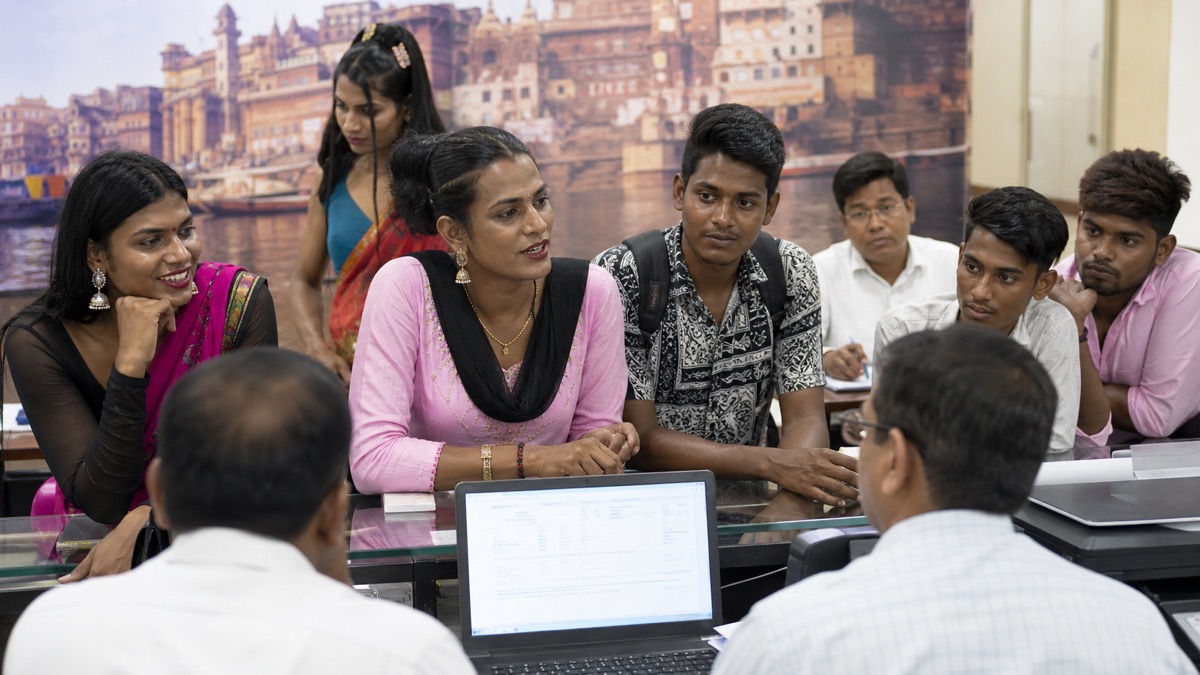
Varanasi: A group of queer and transgender young people visited a government office in Varanasi to seek practical answers about identity documents, public toilets and access to welfare schemes. Their questions were rooted in everyday administration: how to correct or update Aadhaar records, where a person can use a toilet without harassment, and which desk is responsible for helping applicants navigate available benefits.
The visit turned policy language into a test of the city’s service delivery. Rights and schemes may exist on paper, but access often depends on whether a front-desk official knows the procedure, whether forms recognise a person’s identity and whether applicants are treated with dignity. For people whose documents carry different names or gender markers, even a routine application can become a loop between offices.
Aadhaar-related concerns are especially consequential because the number is used across banking, mobile connections and benefit systems. Updating demographic information requires prescribed documents and verification, yet transgender applicants may not have a conventional chain of certificates matching their current identity. India’s national transgender portal and identity-certificate framework were designed to address part of this gap, but awareness among both citizens and local staff remains uneven.
Public toilets present a more immediate physical problem. A facility marked only for men or women can expose a transgender person to questioning, abuse or exclusion. Inclusive toilets are not a symbolic extra; they affect whether someone can study, work, travel or spend time in a public building safely. The group’s inquiry therefore touches urban design as much as social welfare.
The welfare discussion also revealed the value of a single, accountable help point. Applicants should not have to disclose personal information repeatedly while being sent from counter to counter. A trained nodal officer, a clear checklist and a private grievance channel could make existing systems far easier to use. Periodic sensitisation is useful only if it produces measurable changes in how applications are received and resolved.
The young people’s visit deserves to be understood as civic participation, not a request for special treatment. They approached the administration with specific service questions and asked it to make its own processes work. The useful next step would be a written response: where applications should go, what documents are needed, what timelines apply and who can intervene when discrimination occurs. Clarity of that kind would benefit not only queer and transgender residents, but anyone who has struggled to find their way through a government office.
Officials can turn the encounter into a useful service audit by recording how many pending identity applications exist, whether public buildings have inclusive toilets and how long welfare referrals take. Aggregate figures would protect individual privacy while showing whether barriers are shrinking. A follow-up meeting with the same participants would also test whether the answers given at the counter produced actual results.
Sources and reporting
Based on local reporting published on 14 August 2026 about a visit by queer and transgender youth to a government office in Varanasi. The article uses respectful language and treats participants’ questions as reported civic concerns.
Related Stories
Ramnagar Day Three Follows Vishwamitra Into the Forest and Mithila
Shivpur Ramlila Stages Narad Moh and Kshirsagar Tableau Through Rain
VMC Puts City on Alert for Navratri and Durga Puja Civic Arrangements

Chowk Becomes Varanasi's First Police Station With ISO 9001 Certificate
World Tourism Day: Guides Welcome Visitors; Namami Gange Cleans Namo Ghat