If you are flying home for Diwali, there is a good chance a power bank is going into your bag. It is also one of the items most likely to get you pulled aside at security. The rules are not complicated, but most people never check the one number that decides whether their power bank can fly: its watt-hour rating.
Here is a plain guide, based on Air India's official cabin baggage rules and the label on a typical 20,000mAh power bank. Other airlines publish their own rules, which can be stricter, so check your carrier's page before you fly.
Rule one: power banks go in hand baggage only
Air India's cabin baggage guidelines say spare or loose batteries, including lithium-ion batteries for portable electronics, must be carried in hand baggage only. The page states that power banks are considered spare batteries. In other words, a power bank in your checked suitcase breaks the rules, and security may open the bag to remove it.
The same page says spare batteries must be packed individually to prevent short circuits. A power bank thrown loose in a bag with coins, keys or charging cables is exactly what the rule is trying to avoid. A small pouch or the original box is enough.
Rule two: watch the 100Wh limit
Air India says the watt-hour rating of a lithium-ion battery must not exceed 100Wh. For lithium metal batteries, the lithium content must not exceed 2g. Power banks use lithium-ion or lithium-polymer cells, so the 100Wh figure is the one that matters.
The trouble is that power banks are sold by mAh, not Wh. To convert, multiply the mAh figure by the battery voltage and divide by 1,000. Most power bank cells are rated at about 3.6V to 3.85V, and good brands print the exact voltage and Wh figure on the label.
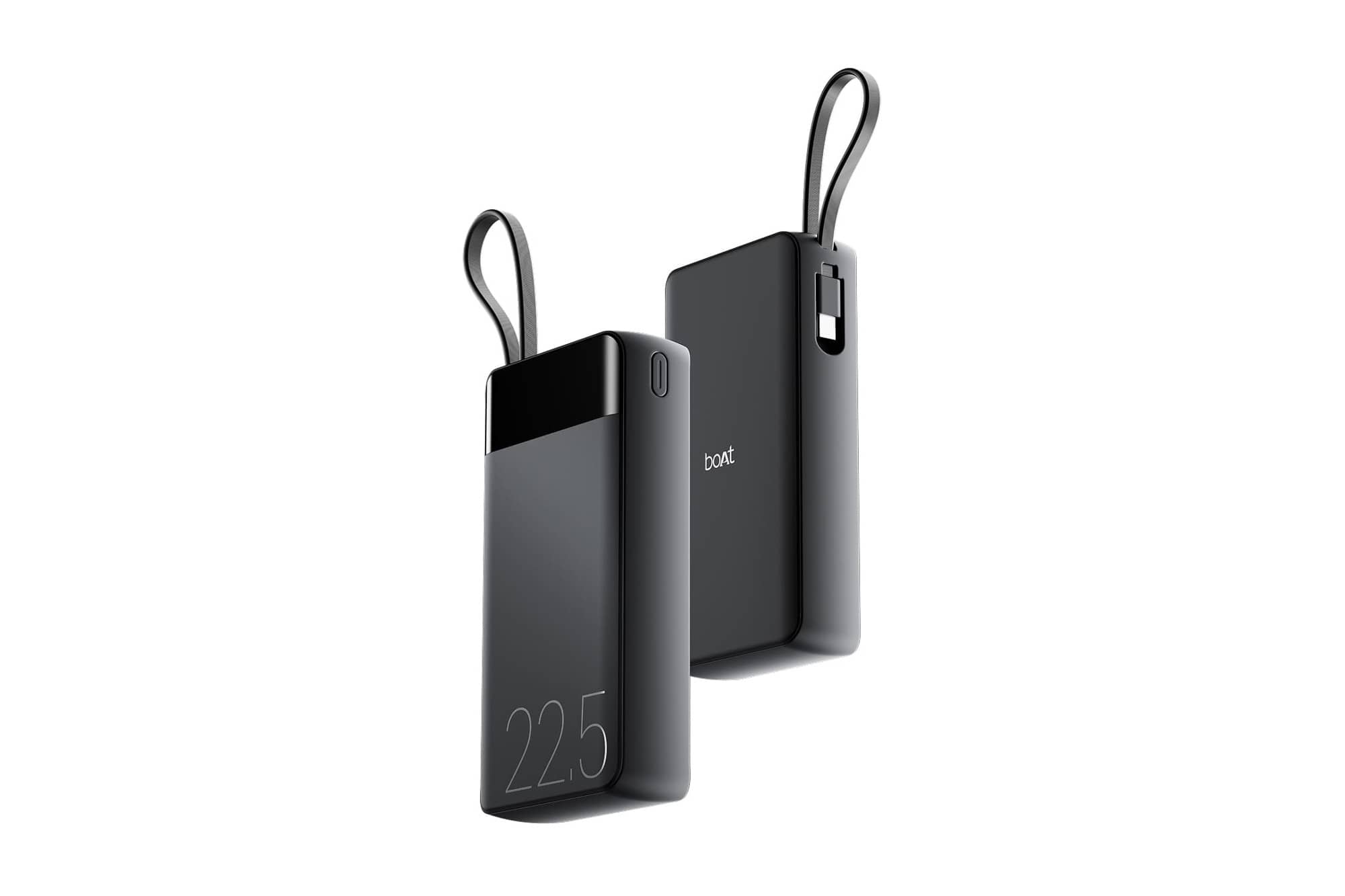
Take the boAt Apex PB400 Pro as a worked example. boAt's official product page lists it as a 20,000mAh power bank at 3.85V with a rating of 77Wh. That is 20,000 x 3.85 / 1,000, which comes to 77Wh, comfortably under 100Wh. boAt lists it at Rs 2,099 (price as of 8 October 2026, 1:55 AM IST), with 22.5W charging and a built-in USB-C cable.
A 10,000mAh power bank at a similar voltage comes to about 37Wh. At around 26,000mAh and above, you start getting close to the 100Wh line, so large laptop power banks are the ones to check carefully. If the label does not show a Wh rating or a voltage, security staff may not accept your word for it. That alone is a good reason to buy from a brand that prints the details.
Rule three: no more than two spares
Air India's page says you can carry a maximum of two spare batteries. Since power banks count as spare batteries, two power banks is the limit on Air India, and that count would also include any loose camera batteries or spare laptop batteries you are carrying. A family of four can each carry their own, but one person carrying five power banks for relatives is asking for trouble.
What about using a power bank during the flight?
Air India's cabin baggage page sets out what you can carry, not whether you may use a power bank once you are on board. Airlines and regulators have tightened their approach to power banks in flight because of incidents of lithium batteries overheating in cabins, and many airlines now restrict using or charging them during the flight or ask passengers to keep them out of overhead bins.
The safe approach is simple. Charge your phone fully before you leave for the airport. Keep the power bank in a bag at your seat, where you can see it, rather than in the overhead bin. Follow the cabin crew's announcement on whether it can be used. If a power bank gets hot, swells or smells of burning, tell the crew at once.
Batteries that sit inside your devices are treated differently from spares. Air India's page says you can carry battery cells for electrical or electronic items as hand baggage, so the laptop, phone and earbuds in your bag are not counted as spare batteries. It is the loose ones, including power banks, that the two-spare limit and the packing rule apply to. If you carry a camera, its spare batteries count too, so plan the total before you pack.
Before you buy one for travel
Features matter less than markings for flying, but a couple are useful. The PB400 Pro, for instance, supports pass-through charging, which means you can charge the power bank and a phone from one wall socket at the airport lounge, and boAt lists 12 layers of protection against short circuit, over-charge and over-discharge.
Many people pick up a new power bank during the festive sales. If travel is part of the plan, look for three things on the product page: the Wh rating, the voltage and a clear capacity in mAh. A swollen or damaged power bank should never fly, and a very cheap unbranded one with no markings is a poor bet at airport security.
Our earlier explainer on typical vs rated battery capacity explains why mAh numbers can differ on the same product. If family is flying in from abroad with gadgets, our guide to the Baggage Rules 2026 and the duty-free allowance covers the customs side.
The quick checklist
Hand baggage only. Under 100Wh, and check the label. No more than two spare batteries on Air India. Packed so the ports cannot short. And on board, keep it with you and follow the crew's instructions. Do those five things and your power bank should not hold you up at security.