CHENNAI: Every large dam, port jetty and river bridge in India has a part nobody can easily see. The concrete and steel under the waterline wears down, cracks and scours, and for decades the only way to check it was to send a diver into cold, murky water, often with poor visibility and a real risk to life. Planys Technologies, a Chennai company that grew out of IIT Madras, builds robots to do that job instead.
The company was formally set up in 2015, though its own account says the work began in 2012 as student research projects at the institute. It now offers underwater inspection as a service to dam operators, ports, refineries and railways, using remotely operated vehicles, autonomous underwater vehicles and crawlers that it designs and builds itself.
Why underwater inspection is hard
Most of what can go wrong with a submerged structure is invisible from the surface. Gates on a dam can corrode, spillways and plunge pools can erode, bridge piers can lose the riverbed around their base, and pipelines at a plant's intake can foul. Reservoirs silt up, which reduces how much water a dam can actually hold.
Planys pitches its robots on three points: they are unmanned, so nobody is put at risk; they can stay in the water for long periods; and in many cases they can inspect without the operator shutting down the asset. The company also combines the robots with non-destructive testing, a set of methods that measure things like steel thickness and corrosion without cutting into the structure. Its core advisers listed on the website are Dr Prabhu Rajgopal and Dr Krishnan Balasubramaniam, both specialists in non-destructive testing.
The robots in its fleet
The product pages list four remotely operated vehicles. ROV ORCA is built for confined spaces such as dams, tanks and pipelines. ROV Beluga is meant for open water like ports and river and highway bridges, and adds sonar imaging to its cameras. Both carry dual HD cameras tuned for turbid water, take modular payloads of up to 10 kg, and are rated for 120 metres of depth, extendable to 300 metres. The company says they have logged 10,000 operational hours.
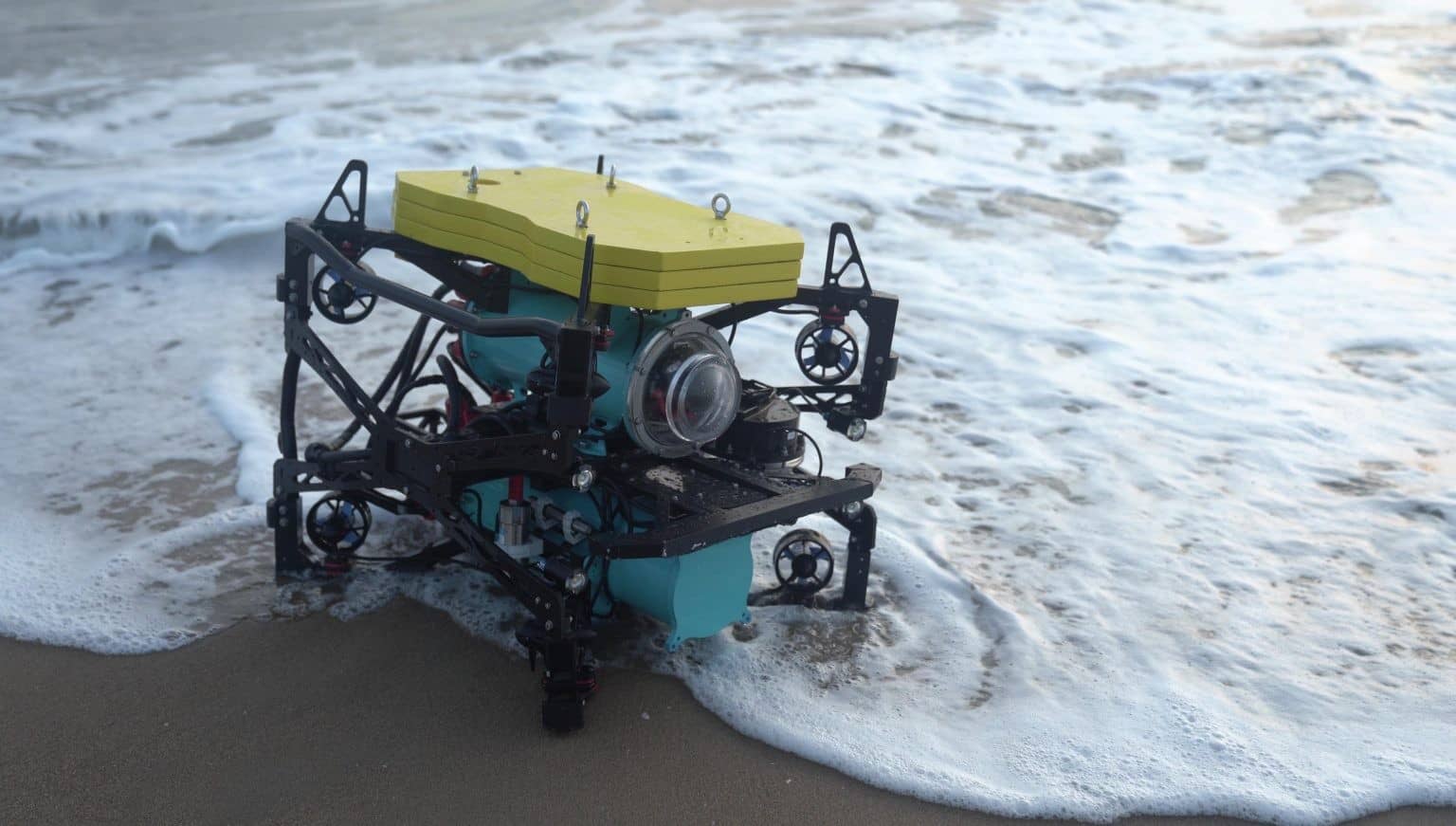
ROV Trikhand is listed for mine countermeasures, a defence role. Jal Avalokini, the robot in the picture above, is described for bridges, ports, ship hull inspection and search and rescue, with live AI-based defect recognition.
The autonomous side has two machines. AUV Svaayatt weighs about 110 kg, can land on the seabed on a skid frame, and runs for up to 10 hours on a 5 kWh rechargeable battery. Planys lists uses including hydrographic surveys, search and rescue, and defence tasks such as anti-submarine warfare and surveillance. AUV Tritanta is a much smaller vehicle, under 15 kg, with up to four hours of endurance, onboard machine learning and optical and hyperspectral cameras. The company openly describes a low-cost variant for expendable defence uses such as decoys.
The data side matters as much as the hardware. Planys says its reports carry geo-tagged defect markers, and its Planys Analytics Dashboard is meant to give asset owners a visual summary they can act on. It also lists an Internet of Underwater Things product line for continuous monitoring.
Who uses it
The client logos on the company's site include Bharat Petroleum, ONGC, Cairn, the Damodar Valley Corporation, Himachal Pradesh Power Corporation, the Daman Ganga dam, East Central Railway, East Coast Railway and the Dedicated Freight Corridor, along with overseas names such as the City of Rotterdam. Planys says it has more than 100 customers and 20,000 hours of operating experience. It also shows a team photo marking an entry into Brunei with Sepakat Energy. These are company claims and Dalimss News has not independently confirmed individual contracts.
The awards page lists a National Startup Award in 2020 from Startup India, a DP World prize from the Ministry of Shipping, a dam safety technology award and an INAE innovator entrepreneur award, among others. The company's media page also notes support from the Technology Development Board under the Department of Science and Technology for commercialising its ROVs.
The team and backers
The founding team named on the website is Tanuj Jhunjhunwala, the CEO, and Vineet Upadhyay, the CTO. Sakshi Inani is listed as chief financial officer. The investor board on the site shows names including Kris Gopalakrishnan, Ranjan Pai, Ashish Kacholia and Krishna Defence, alongside networks such as LetsVenture and Keiretsu Forum. The company does not list round sizes on its own pages.
Planys is not the only Indian company working underwater. Dalimss News has explained how Kochi's EyeROV builds inspection robots for a similar market. IIT Madras, where Planys started, has also become a steady source of deep tech companies, as seen in the Rs 450 crore first close of its Unicorn Frontier fund last month.
Why it matters for India
India has thousands of large dams, many of them decades old, and the Dam Safety Act of 2021 requires owners to carry out regular inspections. Ports are expanding fast, and road and rail bridges over rivers keep getting longer. All of that adds up to a lot of underwater concrete that someone has to check. Robots will not replace divers everywhere, but they make it possible to look more often and with less risk. The thing to watch is how much of this work moves from one-off inspections to permanent monitoring, which is where Planys's sensor products are aimed.