Parliamentary Panel Flags India’s Secondary-School and Accessibility Gaps
A parliamentary committee has asked the Union education ministry and state governments to address two connected weaknesses in India’s school system: too few institutions at the secondary and higher-secondary stages, and incomplete basic access for children with disabilities. Its Tenth Report for 2026-27, presented to the Lok Sabha on August 12, uses national school data to argue that access narrows sharply as children move to higher classes.
The Committee on Estimates cited UDISE+ 2024-25 figures showing 10,92,671 government and government-aided schools. The report counted 9,11,032 schools with primary classes and 4,12,805 with upper-primary classes, compared with 1,61,808 at the secondary stage and 90,866 at higher secondary. A single school may cover more than one stage, so these categories should not be added together as separate institutions. The pattern nevertheless shows how much less widely available the later stages are.
Enrolment also contracts across the sequence. The figures cited in the report move from about 6.18 crore pupils in primary classes to 4.09 crore in Classes 6 to 8, 2.37 crore at secondary level and 1.64 crore at higher secondary. The committee described the final figure as indicating that nearly 73 per cent of the primary-stage cohort is no longer represented by the end of higher secondary.
That comparison is a measure of system-wide contraction, not the official annual dropout rate. It combines several cohorts and can reflect demographic change, grade repetition, movement between school types and children leaving education. The distinction matters. The figures are still alarming, but readers should not interpret them as saying that 73 per cent of one year’s children dropped out during a single academic session.
The committee recommended upgrading existing schools and increasing the number of secondary and higher-secondary institutions so that students do not face an impractical journey after Class 8 or Class 10. Distance is rarely the only reason a child leaves school, but it can amplify costs, safety concerns and the pressure to work—especially for rural pupils and girls.
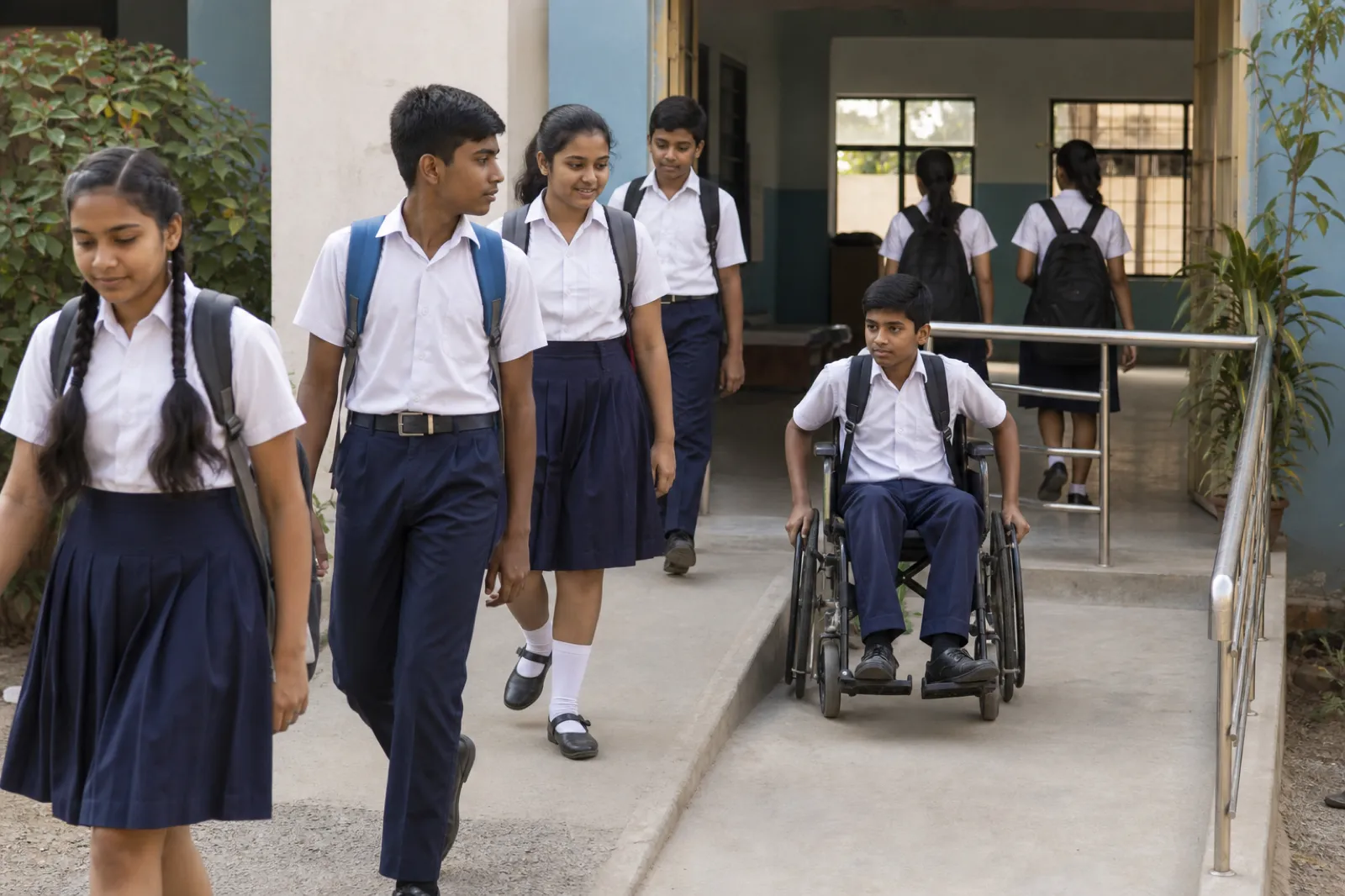
Its accessibility findings were equally stark. Of 14,71,437 schools nationwide, 5,23,143 had toilets identified as suitable for children with special needs, while 8,08,466 had ramps with handrails. A ramp alone does not make a campus accessible: the route to classrooms, width of doors, usable toilets, signage and trained support all shape whether a pupil can participate independently.
The report also pointed to an implementation gap under Samagra Shiksha. It said Rs 4.82 crore was allocated in 2024-25 for 186 CwSN toilets, but recorded expenditure of only Rs 2.60 lakh and no physical progress against that target. The ministry now needs to explain whether this reflected delayed approvals, reporting lags or projects that never moved.
The Rights of Persons with Disabilities Act gives children with benchmark disabilities a right to free education up to 18, while the National Education Policy endorses zero rejection. Those commitments become meaningful only when a nearby school has a usable building, trained staff and a place in the next grade. The committee’s figures therefore offer a practical test for the coming budget cycle: not another declaration, but more children able to reach and use a secondary school.
Sources and reporting
Based on the Tenth Report of the Lok Sabha Committee on Estimates (2026-27), presented on 12 August 2026, and UDISE+ 2024-25 data cited in the report.
Related Stories

SEBI clears Rs 25 lakh PRIM route for mutual-fund portfolios

Samsung starts One UI 9 rollout on Galaxy S26 phones
Sector 17 Food Court Fire Blasts Two LPG Cylinders
Signature Global Plans 194-Acre Farrukhnagar Villas
Malda Arrest in Chakkarpur POCSO Case