
Noida Caps Smart-Board Time in Primary and Upper-Primary Classes
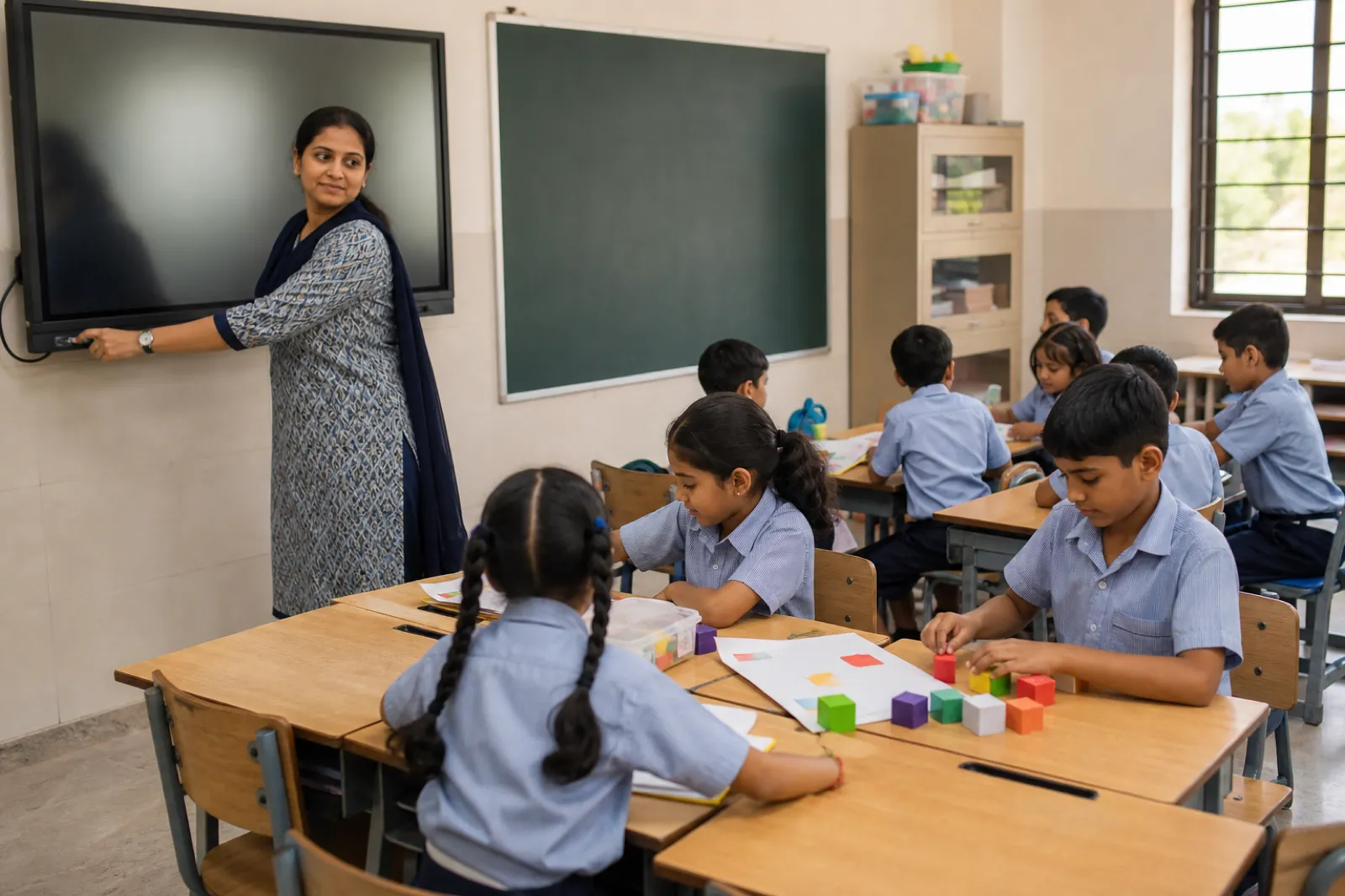
Schools in Noida and Greater Noida have been directed to limit daily use of smart and digital boards after parents complained that some children were spending four to five classroom hours looking at screens. Gautam Buddh Nagar’s administration has set a 30-minute daily ceiling for primary classes and 60 minutes for upper-primary classes across government, aided and private schools.
The district’s instruction does not ban educational technology. It defines the screen as a supplementary tool for a difficult concept, image, video or other material that benefits from display. Textbook reading, written practice, questions, discussion and participatory work are expected to return to blackboards, whiteboards, greenboards and physical activity rather than remaining on a projected page.
That distinction addresses a common implementation problem. A smart board can widen the material available to a teacher, but continuous display may simply move a printed book onto a brighter surface. The lesson is not more interactive merely because it is digital. Effective use depends on what pupils do before, during and after the display.
The administration cited risks including eye strain, headaches, reduced concentration and short-sightedness. Screen exposure is only one factor in child eye health, and the guidelines should not be presented as a medical guarantee. They are a precautionary effort to rebalance classroom time, viewing distance, outdoor activity and near work.
Schools have been told to provide a break after about 20 minutes of screen use, manage brightness and room lighting and ensure pupils sit at an appropriate distance. The guidelines also invoke the 20-20-20 practice: after 20 minutes of near screen work, look at something roughly 20 feet away for 20 seconds. For online classes, institutions are to follow NCERT guidance on session length and breaks.
Quarterly eye examinations are another part of the district’s plan, with reports to be shared with parents. Screening can identify a child who needs a full examination, but schools should be clear that it is not a diagnosis. Families should receive a referral path and privacy protection for health information.
The administration has encouraged digital-free periods, zero-screen days and activities involving reading, sport, creativity and peer interaction. Those measures will be more meaningful than a simple timer if teachers receive lesson-planning support. Otherwise, schools may switch off a screen without giving staff the books, materials or class size needed for a strong alternative.
Designated magistrates and nodal officers will monitor compliance and report through the District Inspector of Schools. Monitoring should sample timetables and classrooms rather than rely only on a self-certified register. School management committees are expected to discuss the policy and share minutes with parents during meetings.
Parents should not read the limits as a statement that every minute of classroom screen use is harmful. The policy is about purpose and proportion. A short animation can clarify a scientific process; four hours of projected worksheets cannot.
The district has set an unusually concrete rule. Its value will be judged by whether teaching becomes more varied—more writing, conversation, movement and hands-on work—rather than by whether a board is dark for exactly the required number of minutes.
Sources and reporting
Based on Gautam Buddh Nagar district administration guidelines issued after parent complaints and reported on 14 August 2026.
Related Stories

Two Held for Alleged Bid to Run Over Men
Retired HSVP Officer Surrenders in SCO Plot Case

Cops Warn Weekend Bikers After Recent Crashes
HT Pole Still Blocks Road Between Sectors 102, 102A
HSVP Plans Single City Office in Sector 16