Five-Year-Old NHAI Roads Around Varanasi Already Crumbling, Report Finds
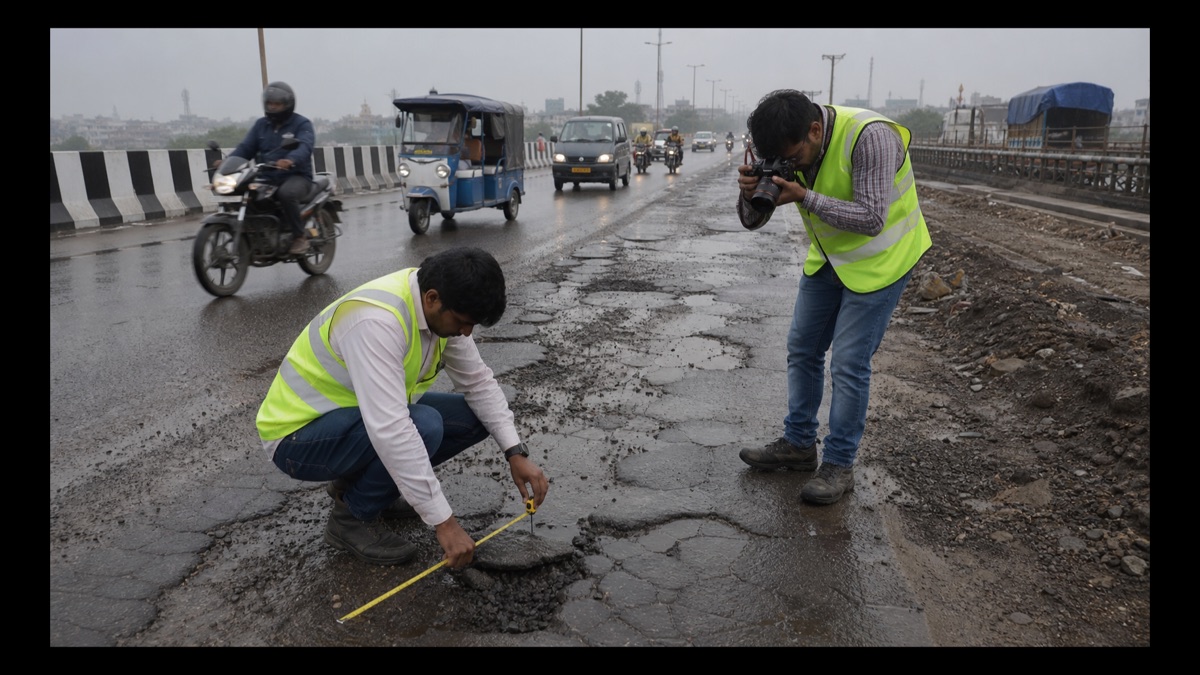
VARANASI: Concrete road sections built to carry heavy traffic between Varanasi and Ghazipur are already depending on extensive repair patches after only about five to seven years, according to a field report published on Monday. Several patches are themselves breaking at the edges or settling unevenly, creating sharp changes in level that are especially hazardous for two-wheelers in rain and darkness.
The affected route contains places where the concrete slab has been cut and repaired rather than replaced as one continuous section. That technique can be appropriate when a local defect is isolated, but repeated patches across a relatively young road raise questions about the original construction, drainage, loading and maintenance response. A photograph of a failed patch can show the symptom, not the underlying cause.
Concrete pavement depends on the entire structure below it. The strength and compaction of the soil, granular sub-base, drainage, slab thickness, joints, concrete mix and curing all influence whether the surface carries traffic for its intended life. Water entering through a failed joint can erode support under a slab, while overloaded vehicles and poor edge drainage can accelerate movement.
The report estimated that a two-lane, seven-metre-wide concrete road can cost roughly ₹2.5 crore to ₹4 crore per kilometre or more, depending on design and site conditions. That is a broad construction range, not the audited cost of a specific Varanasi package. NHAI should publish the contract details, completion date, defect-liability terms and latest pavement-condition survey before any financial conclusion is drawn.
Road users need immediate protection while the engineering questions are examined. Broken patch edges should be marked with reflective warnings and temporarily made level, particularly before night. Water must be drained rather than allowed to conceal the depth of a defect. Repairs should be planned to maintain a safe lane and not leave abrupt cuts open to traffic.
A durable fix begins with diagnosis. Engineers should test slab movement, drainage, joint condition and support beneath recurring failures. Simply placing another layer over a moving or waterlogged base can produce the next visible “stitch” within months. Core tests and geotagged maintenance records would make it easier to identify whether defects cluster around one contractor, material batch or drainage feature.
For motorcyclists, the safest response is to reduce speed, avoid sudden swerves and maintain distance from larger vehicles that hide the road surface. Defects can be reported with a location pin and a photograph taken only from a safe place.
The public paid for a road designed to outlast a few monsoons. The answer should not be a cycle of anonymous patches. A transparent technical audit, followed by repair that addresses the failed layer rather than the visible crack alone, is the minimum owed to commuters on the Varanasi–Ghazipur corridor.
Sources and reporting
Based on an August 17, 2026 Jagran field report on concrete NHAI stretches on the Varanasi–Ghazipur route. Project-specific costs and defect causes require official engineering records.
Related Stories
FIR Against Cab Driver After Sector 69 Toddler Hurt
Railways Clears Banaras–Prayagraj Rambagh MEMU Pair
Haryana Clears Phase 2 Metro Civil Works Package
MLC Forms Reach 30 Over Two Days; Still No Papers Filed

Italian Woman FIRs Alleged Gurugram Romance Scam