CHENNAI: Mindgrove Technologies, the IIT Madras Research Park chip design startup, says its Secure IoT S2401 microcontroller is headed to market in late 2026, according to the milestones on its about page. The company calls the S2401 India's first commercial-grade high-performance microcontroller with built-in security for IoT and embedded systems.
Mindgrove is a fabless company, which means it designs chips and has them made at outside foundries. It was formed in February 2021 and, in its own words, started "from a small room in Chennai" with the aim of proving that production-grade silicon could be designed in India.
What the Secure IoT S2401 chip is
The official S2401 product page describes a single-core 64-bit Shakti C-Class CPU based on the open RISC-V standard (RV64GC), running at 700 MHz. The Shakti processor family has its roots at IIT Madras. Mindgrove's homepage says the chip is built on a 28 nm process and aimed at low-power IoT and embedded devices.
Security is the selling point. The chip has hardware crypto accelerators and on-chip secure memory, which Mindgrove describes as security baked into the silicon. For memory, there is a large on-chip SRAM for time-critical work and two QSPI interfaces for NAND or NOR flash or PSRAM, with execute-in-place support. Peak power is listed at under 200 mW, with a 0.9 V core and 1.8 V input and output.
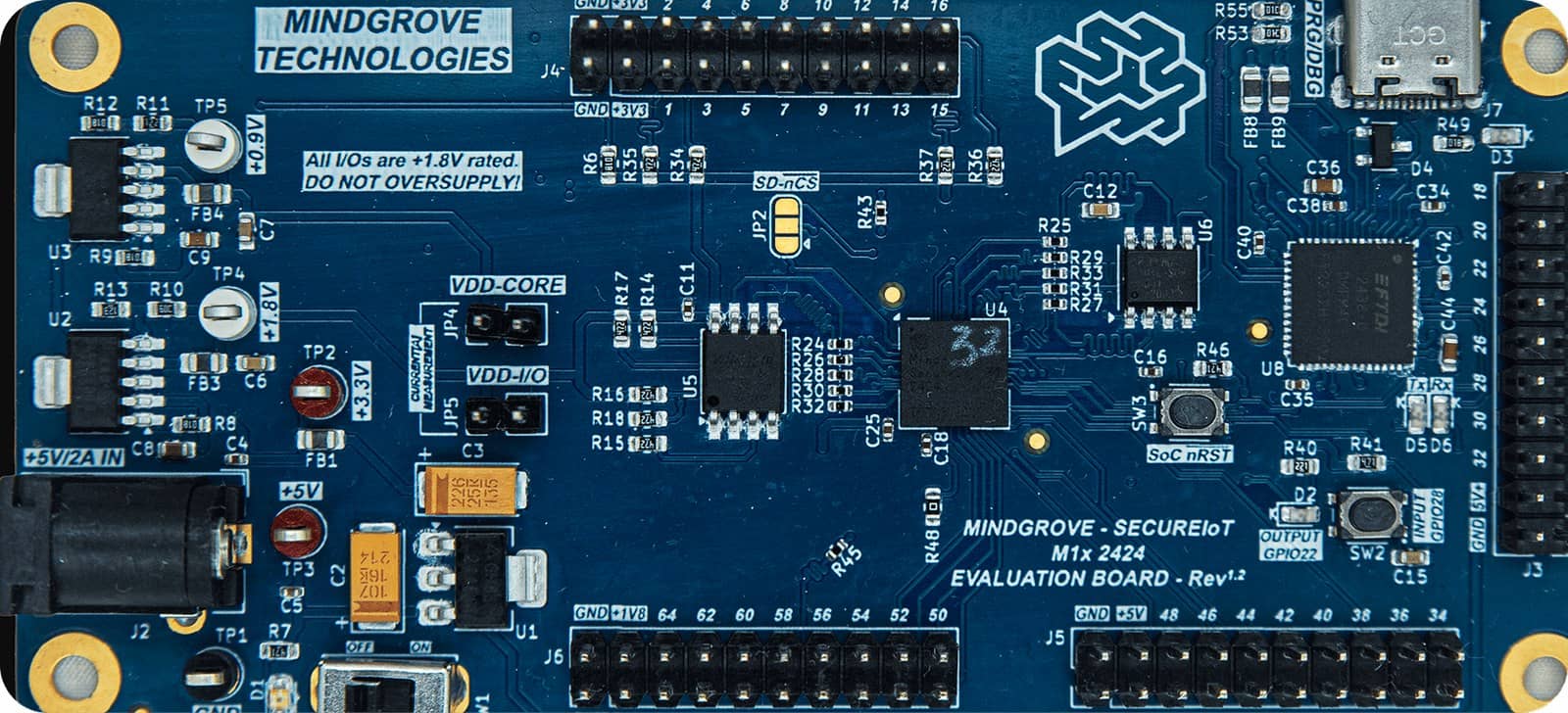
The S2401 comes in two packages, a 144-ball BGA and a 64-pin QFN, and is built to run Zephyr and FreeRTOS. Mindgrove sells an evaluation board and a compact system-on-module, the M1x 2424, so device makers can test and integrate the chip faster. Data sheets, an API reference and user manuals are posted on the product page.
From seed round to market
The milestone list on the about page traces the path. Mindgrove raised a seed round of $2.32 million in February 2023, secured Rs 15 crore of Design Linked Incentive funding in February 2024 for its second chip family, and taped out the Secure IoT chip on its first attempt in May 2024. It raised $8 million in Series A funding in December 2024 and launched the S2401 evaluation board in March 2025. The company marked five years in February 2026.
The second family, Vision SoC, is a GHz-class processor for edge computer vision in industrial, automotive and consumer devices, with V2600 and V2601 parts listed. An edge compute line for AI inference is marked as coming soon. Mindgrove's media page also lists a June 2025 partnership with Bosch on indigenous semiconductor design.
The target uses are everyday products. Mindgrove lists smart locks, smartwatches, smart meters, thermal printers, smart fans and fingerprint modules on its contact form, and names automotive infotainment and telematics, wearables, factory controllers, CCTV and IP cameras and biometric terminals among applications.
Smart meters are a good example of why this matters. India is rolling out crores of them, and the power ministry wants domestic chips in the mix, as our report on the smart meter domestic chip mandate by mid-2028 explains. An Indian-designed secure microcontroller could compete for that kind of business, provided it meets price, supply and certification needs.
Other Indian deeptech hardware we have covered includes Quanastra's quantum detectors, another IIT Madras-linked startup, and ShepHertz's offline AI models built for constrained devices.
RISC-V is worth a word of explanation for general readers. It is an open instruction set, which means any company can design a processor that follows it without paying licence fees to a single owner. That has made it popular with chip startups and with governments that want more control over the technology inside their devices. Mindgrove's bet is that a secure RISC-V microcontroller designed in India can compete on price and performance with established imported parts in the same class.
Being "in market" is a big step for any chip startup. Device makers will look for steady supply, long-term availability guarantees, software support and a competitive unit price against imported microcontrollers. Mindgrove lists info@mindgrovetech.in for queries and says its team is based at D3 06, IIT Madras Research Park, Taramani.