
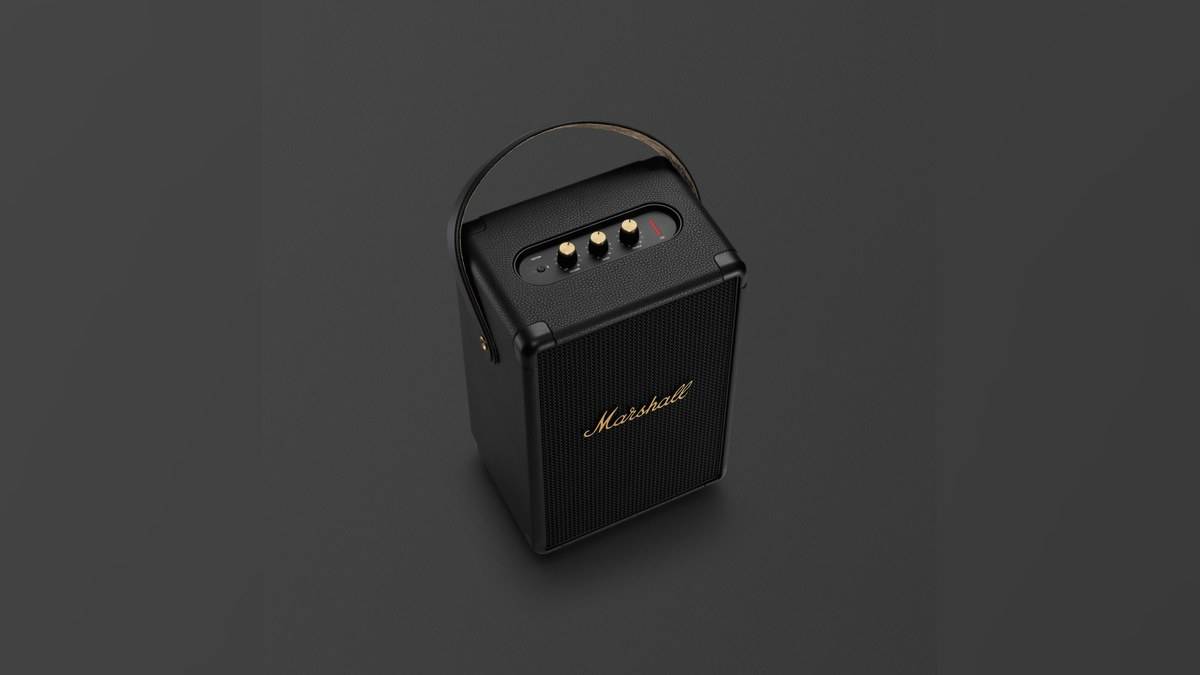
NEW DELHI: Marshall Tufton is listed at Rs 34,999 in Black and Brass on the brand's India store, against an MRP of Rs 47,999. It is a battery-powered stereo speaker with Bluetooth and an AUX input, built around physical volume, bass and treble controls. Its standalone operation is an essential distinction for anyone planning a connected home-audio system.
| Item | Official detail |
|---|---|
| Verified finish | Black and Brass |
| Listed price | Rs 34,999 |
| MRP | Rs 47,999 |
| Battery claim | 20+ hours |
| Connections | Bluetooth 5.0; 3.5 mm input |
| Weight | 4.9 kg |
| Dimensions, width x height x depth | 229 x 350 x 163 mm |
| Water resistance | IPX2 |
Price as of 24 November 2026, 23:40 IST. Only the Black and Brass configuration above has been price-verified for this guide. The store's wider colourway description is not evidence that every finish has the same current India price or availability.
A portable cabinet that needs a place in the room
Tufton's carrying strap does not make its cabinet disappear into the luggage allowance. Its listed weight makes it a speaker to move deliberately between locations, rather than something to leave attached to a small day bag. Consider where it will stand and how it will travel before making the battery claim the main selection criterion.
Marshall's official product description identifies a three-way design and a rear-facing driver. The company calls its multidirectional approach True Stereophonic. In practical planning terms, the rear of the cabinet deserves consideration alongside the front grille when choosing a position. This guide does not substitute a claimed acoustic design for an independent listening assessment.
The cabinet also has no microphone system or Wi-Fi in the official specification. That makes Tufton a focused music-playback device, rather than a hands-free calling speaker or a network audio endpoint. The controls are on the speaker itself. Separate bass and treble adjustment may suit a household where different people play music and prefer an immediate knob adjustment. That interaction is also relevant for listeners who do not want basic tone changes to depend on navigating a phone application.
Standalone means something specific here
Marshall's Tufton support page states that no Marshall-branded app supports the speaker. It also says Tufton cannot be used in pairs or multiple groups. Those limitations should be part of the original purchase decision if the intended project is synchronised sound across rooms.
There is a separate distinction between connecting source devices and connecting speakers. The official pairing guide permits two Bluetooth devices to remain connected to Tufton. Playing music from one selects it as the audio source and pauses playback from the other. That is a source-handover arrangement, rather than a way to build a wireless speaker pair.
For a couple or shared household, that source behaviour can be useful: each person can keep a device connected. It also means a second person's playback can interrupt the first. Agreeing who controls the music is a more useful preparation than assuming both devices will mix together.
Bluetooth and wired playback
To pair a source, Marshall instructs owners to hold the Bluetooth button for two seconds, wait for the indicator to blink and select Tufton in the source device's Bluetooth list. A steady indicator confirms the connection. These steps are separate from the power and volume control.
The rear AUX input accepts a 3.5 mm stereo connection from a music player's audio output. For an older player or a computer with an appropriate analogue output, that gives a straightforward alternative to wireless pairing. Check the source's actual sockets before assuming a phone can connect by cable without additional equipment.
Battery use and charging at home
The support page qualifies the battery expectation as approximately 20 hours at medium volume. Its charging guide gives an approximate empty-to-full time of 2.5 hours. Neither figure should be treated as proof of the same result at every volume or with every type of programme material.
Charging uses a mains lead behind the rear silicone door. Marshall instructs owners to connect the speaker and wall socket, then unplug from the wall before removing the lead from the speaker once charging is complete. Close the silicone door afterwards. This is a different routine from treating the speaker as a USB-powered desktop accessory.
Who it is for, and the alternatives
Tufton makes the most sense for a listener who wants a substantial movable music cabinet with local controls and accepts standalone playback. For a fixed furniture-side setup, see our Watch and audio price guide. For a different portable approach, our Marshall Stanmore III vs Acton III price: Acton III starts lower at Rs 20,999 is relevant, while the JBL Xtreme 4 price: Rs 20,999 for the Black model covers a party-oriented alternative.
Sources: Marshall India product page, Tufton support, connection guide and charging guide.