IIT Madras and the Human Welfare Association have signed an MoU to build technology for authenticating and tracing India's Geographical Indication (GI) tagged crafts and products. The institute announced the tie-up in a press release dated 1 October 2026. The agreement was signed "recently", the release says, without giving a date.
Dr Rajni Kant, General Secretary of the Human Welfare Association, and Prof. Manu Santhanam, Dean (CSR) at IIT Madras, signed the MoU. IIT Madras Director Prof. V. Kamakoti was present, along with project coordinators Prof. M. Manivannan and Prof. John Augustine.
What the project will work on
A GI tag marks goods as coming from a particular place, with qualities linked to it. Banarasi silk, Darjeeling tea and Kancheepuram sarees are familiar examples. The difficulty for the people who make such goods is that a buyer has little means of confirming origin at the point of sale.
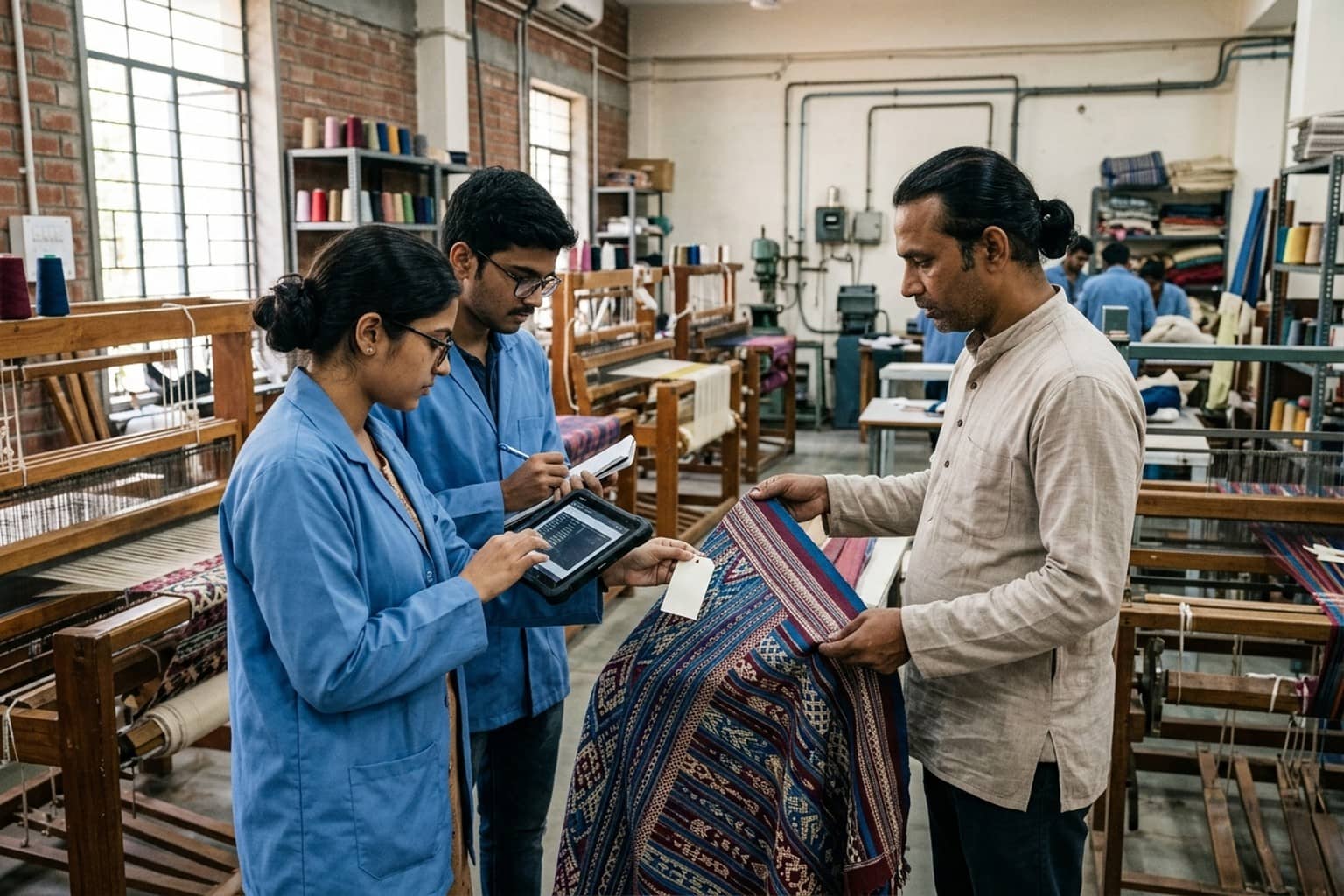
The work is to cover digital authentication, product traceability, documentation and other technology-based measures for GI-tagged goods. According to the institute, the aim is to help artisans and producer communities prove that a product is genuine, which in turn should raise buyer confidence, protect cultural identity and open up more sustainable livelihoods.
The initiative will be supported by the Artisan Empowerment Lab at IIT Madras, which the release describes as developing scalable technology approaches for artisans, producer groups and others in the GI ecosystem. Researchers, artisans, farmers and producer communities, industry partners, government bodies and social-development organisations are all named as participants in building what the institute calls practical models.
The release also speaks of the "preservation, recognition, authentication and sustainable growth" of India's craft and agricultural heritage, and it names farmers alongside artisans and weavers. It says the MoU combines the Association's ground-level engagement with artisan communities and IIT Madras's research and technology capabilities.
What the researchers said
Prof. Manivannan, of the Department of Applied Mechanics and Biomedical Engineering, is quoted as saying that artisans form India's second-largest population and that technology can drive "transformative impact" for them.
Prof. John Augustine, of the Department of Computer Science and Engineering, described the problem in terms of trust. "Buyers value authenticity but cannot verify it," he said, adding that the goal is a shared trust infrastructure that lets anyone check an artisan's identity and a product's origin.
Dr Rajni Kant, whom the release calls the "GI Man of India", said the project could boost the Atmanirbhar Bharat and Viksit Bharat campaigns internationally and could benefit millions of artisans, weavers, producers, farmers and women if scaled nationally. The release credits him with helping secure numerous GI tags for traditional handicrafts and local artisan communities.
What is not yet known
The press release is an announcement of intent. It gives no budget, no timeline, no list of crafts or states where work will begin, and no description of the authentication method, such as tags, records or a registry.
For readers following how Indian institutes work with outside bodies, the point to note is the partner. An association whose founder helped secure many GI tags is pairing with an engineering institute whose project leads come from applied mechanics, biomedical engineering and computer science. Any later announcement of pilots, funding or products will be posted on the IIT Madras press release page.