
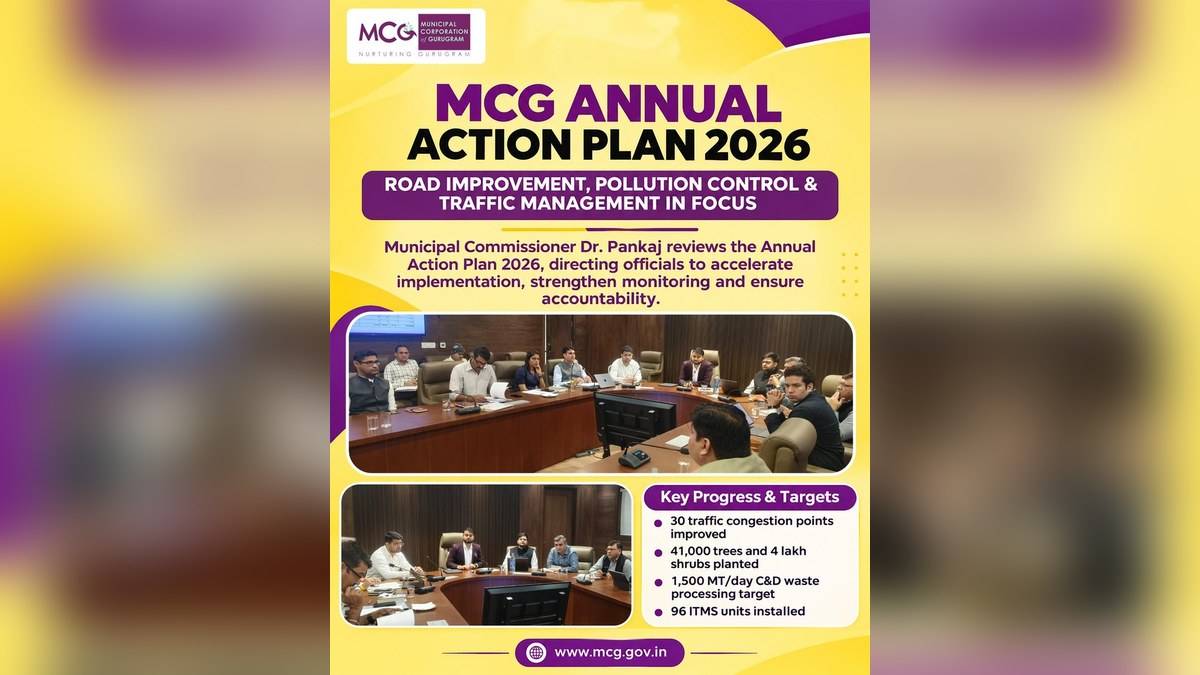
GURUGRAM: The Municipal Corporation of Gurugram reported improvements at 30 traffic congestion points on Wednesday, November 25, 2026, during a review of its Annual Action Plan 2026. Municipal commissioner Dr Pankaj reviewed road infrastructure, pollution control, waste management and traffic measures, an update relevant to commuters using corridors such as the Sector 41/45 junction, Subhash Chowk and Signature Tower that appear in the original plan.
The corporation's official update, published at 3:49 pm IST, also recorded 41,000 trees and 400,000 shrubs planted. It asked officials to accelerate pending work, improve monitoring and strengthen accountability. These are figures reported by the corporation at the review; the update does not provide independent measurements of journey times or the survival rate of the planting.
What the traffic progress figure covers
The municipal review announcement identifies 30 congestion points as improved. The original 2026 annual action plan, sent on December 30, 2025, sets out 33 points requiring short term intervention. Its quarterly programme includes Signature Tower, Sector 4/5 Chowk, Palam Vihar's Rezangla Chowk, Bakhtawar Chowk and the Sector 41/45 signal.
That older document separately lists six locations or stretches requiring longer term intervention, including Bilaspur Chowk, Manesar bus stand and the Rajeev Chowk to Sirhol Border corridor. The distinction matters: the November review's headline tally should not be read as confirmation that every larger highway project in the annual programme has been completed.
The published review does not identify the three remaining short term points individually. Residents therefore cannot use the citywide total to establish the completion status of a particular junction. The earlier plan provides the locations and intended timetable; the new municipal statement provides the latest aggregate progress figure.
Planting totals and the debris processing target
The corporation's review graphic places planting alongside road improvements and waste processing. It records 41,000 trees and four lakh shrubs planted, but gives no sector breakdown or dates for individual planting drives. The figures describe the programme's reported planting output rather than a count confined to November 25.
On construction and demolition waste, the official graphic uses a daily processing target of 1,500 metric tonnes. That wording is significant for residents arranging disposal of building debris: a processing target is a programme objective, and the graphic does not supply a daily weighbridge record establishing actual throughput. The review calls for faster implementation and stronger monitoring of unfinished work.
- Review date: November 25, 2026.
- Traffic points reported improved: 30.
- Planting reported: 41,000 trees and 400,000 shrubs.
- Construction and demolition waste processing target: 1,500 metric tonnes a day.
Field checks and road work are the next tests
A subsequent municipal engineering update on November 26 sets out how the commissioner wants development work supervised. It requires regular field inspections and a site clearance certificate before an estimate is prepared. For work exceeding Rs 50 lakh, sample reports are to be sent to the commissioner's office. Agencies responsible for lapses are to receive notices within a week.
The engineering directions create checks at different stages of a project: site readiness before costing, inspection while work is under way, and sample reporting for larger contracts. The Rs 50 lakh threshold applies to the sample report requirement described in the announcement. The instruction for regular field inspections is broader. The municipal statement also separates the one week period for issuing notices to agencies from the January to May road programme, so those dates should be followed against the specific action each covers.
The same update directs officials to survey all roads, begin work in January and complete it by the end of May. Those instructions concern the next stage of road work. They give residents a timetable against which to follow future implementation, while the November 25 review records progress already claimed under the annual programme.
Street maintenance was also visible in a separate municipal update dated November 26 from Sector 33, near Central Park II. The corporation said workers were manually clearing compacted soil and accumulated debris along road kerbs. This identifies a specific maintenance operation behind the broader road dust programme, although the post supplies no measured reduction in pollution.
Residents following these programmes can compare the new review with earlier local reporting on road cleaning deadlines and inspections, the repair deadline for road sweeping machines and physical checks of pollution complaints. Each concerns a separate implementation measure. The current review adds the corporation's latest traffic and planting totals, with pending work still subject to monitoring.