Forty Uttarakhand College Teachers Study BHU’s Academic and Research Systems
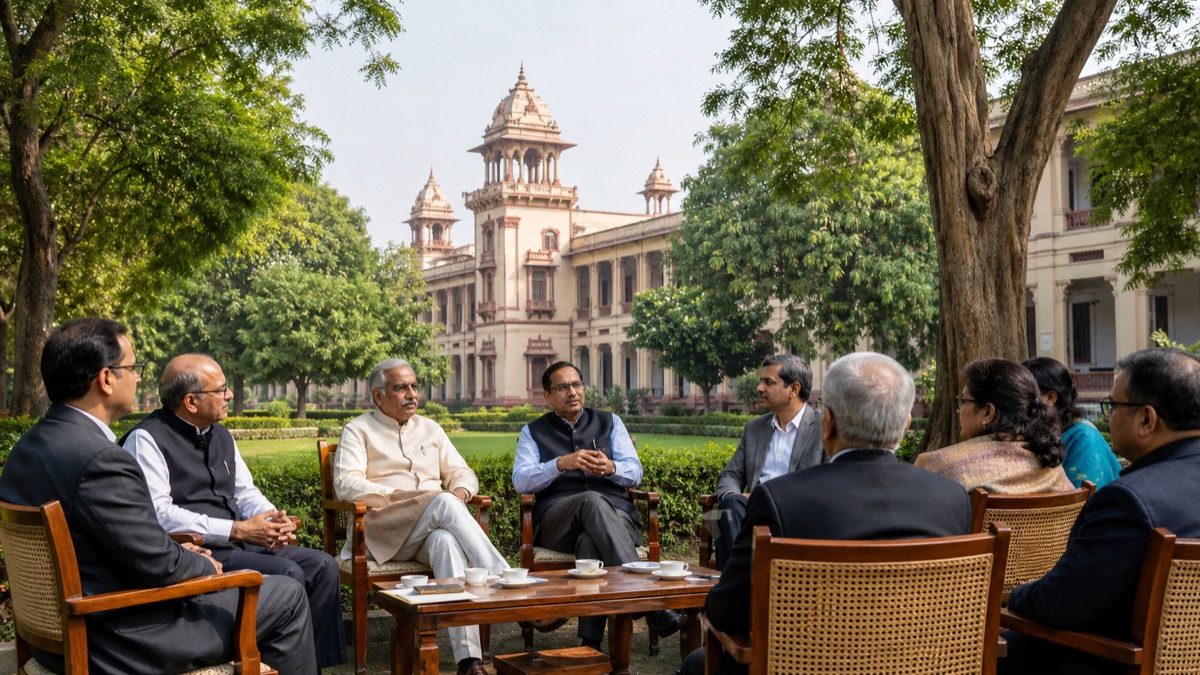
A 40-member delegation of government-college teachers from Uttarakhand has visited Banaras Hindu University to study how a large residential university manages teaching, research and administration. The group met BHU Vice-Chancellor Prof Ajit Kumar Chaturvedi and discussed practices that could travel back to colleges operating in very different institutional settings.
The visit forms part of Uttarakhand’s Chief Minister’s Higher Education Quality Enhancement and Knowledge Enrichment Programme. Participants described the exposure to BHU’s academic and research ecosystem as useful, while the vice-chancellor argued that teachers, like students, benefit from structured educational tours that allow them to see how other institutions organise work.
That observation sounds simple, but teacher mobility is often treated as an optional extra. Faculty members working in smaller colleges may have limited access to specialised laboratories, cross-disciplinary seminars or administrative models beyond their own campus. A visit can widen that view, although the real gain comes only when participants are given time and authority to adapt relevant practices rather than submit a ceremonial report.
BHU also stands to learn from the exchange. Government colleges in Uttarakhand serve dispersed and often remote communities, where geography shapes attendance, staffing and digital access. Their teachers bring experience with constraints that a metropolitan-scale university may not face in the same way. A useful partnership should therefore move in both directions, with the visiting group treated as practitioners rather than passive observers.
The value of an academic initiative lies in what changes after the photographs and speeches. Useful collaboration should produce a timetable, named coordinators and an outcome that students or teachers can actually use: a shared course, laboratory access, mentoring, training material or a documented exchange of practice. Without that follow-through, even a thoughtful visit risks becoming ceremonial. With it, a short interaction can open durable channels between institutions.
BHU’s scale gives such exchanges wider relevance to eastern Uttar Pradesh, but scale also raises the bar for transparency. Participants should know how opportunities will be selected, whether smaller colleges can join and how results will be evaluated. The most credible programmes state their limits as clearly as their ambition. That helps students distinguish an immediate benefit from a longer-term possibility and prevents routine institutional language from being mistaken for a completed reform.
What deserves watching now is the paper trail: minutes, proposals, schedules and any public call for participation. Those documents reveal whether ideas discussed in a room reach departments and classrooms. Until then, the development is best understood as a promising opening rather than a finished outcome. The reporting here stays with what organisers and officials have confirmed and does not assign partnerships, funding or deliverables that have not yet been announced.
Sources and reporting
Reported on 8-9 August 2026 from BHU's interaction with a 40-member Uttarakhand government-college delegation.
Related Stories

UGC-NET June 2026 e-certificates out for JRF, Assistant Professor and PhD qualifiers
NTA opens RMS CET 2026 applications for Class VI and IX; exam on 13 December
CBSE asks schools to share revised National Scholarship Portal framework for 2026-27
CBSE opens List of Candidates window for Class X and XII main exams 2026-27 from 24 September
Tamil Nadu opens MDS Round 2 choice filling from 2 PM on 24 September after resigned seats added