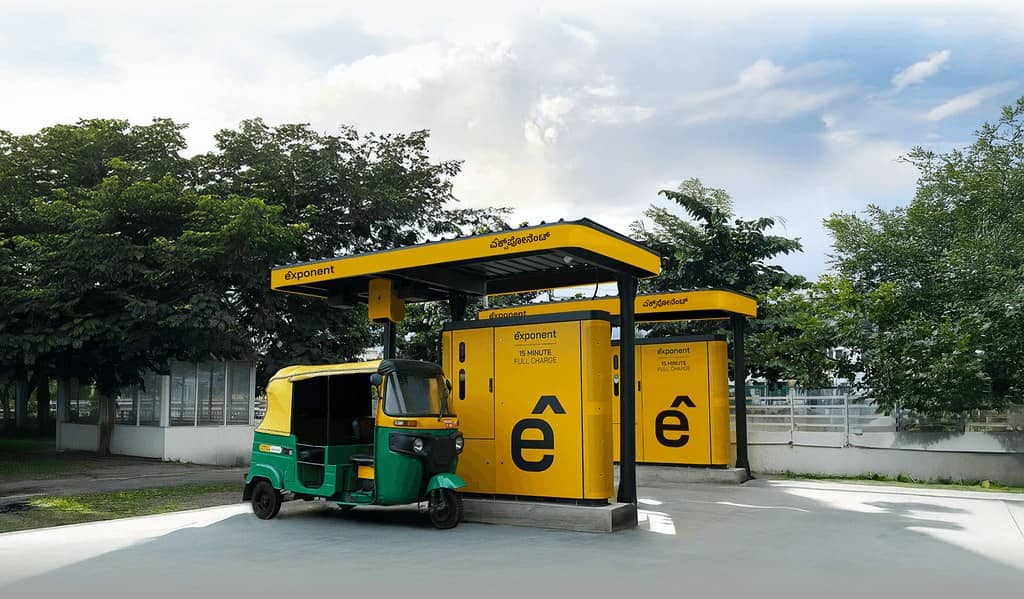
BENGALURU: Exponent Energy, the Bengaluru electric vehicle energy startup, says its system can rapid charge a commercial EV in 15 minutes using regular lithium iron phosphate cells, while backing the battery with a 3,000 cycle warranty. Its technology page, reviewed on 6 October 2026, also says the same stack now scales up to 1.5 MW charging for buses.
That combination is the company's whole argument. Most fast charging trades battery life for speed. Exponent says it has re-engineered the battery, the charger and the software together so that a fleet operator does not have to choose between the two.
How Exponent says 15 minute charging works
The company's homepage lays out the problem with numbers. It says LFP cells can last more than 4,000 cycles in principle. Standard constant current, constant voltage charging extracts about 1,000 cycles even with four hour charge times, according to Exponent, and rapid charging done the conventional way delivers only 300 to 400 cycles. Exponent claims its stack keeps cell life high even with daily rapid charging, and says the battery degradation after 3,000 cycles of testing was certified by TUV India.
A key design choice is where the cooling sits. Exponent points out that a commercial vehicle generates very little heat in its battery while driving, at an average of about 0.3C, but rapid charging at around 4C generates roughly 200 times that heat. So instead of putting a heavy cooling system in every vehicle, it puts the HVAC in the charger and cools the battery from outside during the charge.
The company gives a sense of scale. A three-wheeler with a battery of about 10 kWh would need a 1 to 2 tonne cooling system weighing around 150 kg, it says, while a bus with a 400 kWh pack charging at 1.5 MW would need 30 to 50 tonnes of cooling, which it calls near impossible to fit on a bus. Off-board cooling also lets several vehicles share one chiller.
On the battery side, Exponent uses a master and slave battery management system. Each sub-pack has its own BMS and a virtual cell model, while a master BMS coordinates charging across the pack. The company says this lets the design scale to bus packs of 400 kWh and more.
From autorickshaws to buses
Exponent describes its approach as cell agnostic, meaning it can work with cells from different makers and with newer chemistries later. It says that makes it the only affordable and scalable rapid charging technology in the world; that is a company claim, and fleet buyers will want to see real-world uptime and cost data. The site also mentions the e^xponent network of rapid public charging stations, interoperability and the option of regular charging at any socket.
The company's blog adds context on its thinking. Posts argue that swappable batteries are an operational band-aid for most vehicles, that reusing EV batteries for grid storage is harder than it sounds and that recycling is the better route, and that retrofitting old diesel commercial vehicles with electric powertrains can speed up fleet conversion. An April 2026 post by Vishnu and Pranav describes the company's flexible manufacturing setup.
This sits in the middle of a lively debate on how India's commercial fleets should go electric. Battery swapping has its own backers, as our report on Battery Smart's swap network funding shows, and electric three-wheeler makers such as Euler Motors are scaling fast. For a look at cell-level work, see our piece on TRIOLT Energy's EV cells.
For a fleet owner, the questions are simple. How many chargers are within reach of my routes, what does a kWh cost there, and what does the 3,000 cycle warranty actually cover? Exponent lists partnerships@exponent.energy for business queries on its site.
Exponent's site also carries separate Retrofit and Vehicles sections, and the company describes its work as full-stack innovation across batteries, chargers and everything in between, so it presents itself as more than a charging network.
Exponent has not published per-kWh charging prices on the pages we reviewed. As buses move to electric power in Indian cities, the 1.5 MW claim will be the one to watch.