
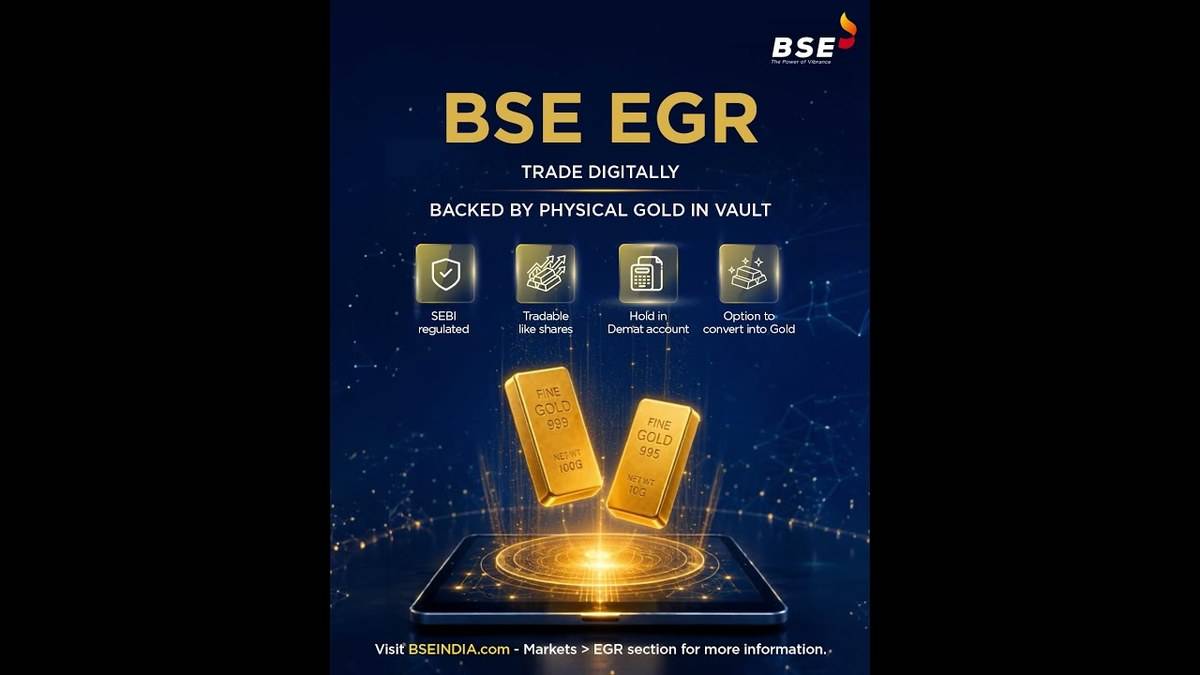
An electronic gold receipt, or EGR, is a security representing physical gold held with a registered vault manager. It can be held in a demat account and traded on a recognised stock exchange. A holder can also request conversion back into physical gold through the prescribed withdrawal process.
The legal status matters when reading an account or product description. NSDL's official EGR guide records that the government declared EGRs securities through notification S.O. 5401(E), dated 24 December 2021, under the Securities Contracts (Regulation) Act, 1956. An electronic receipt in this system therefore has a specific regulatory meaning.
| Question | What the official framework says |
|---|---|
| Where is the holding recorded? | In the beneficial owner's demat account |
| Who keeps the gold? | A SEBI registered vault manager |
| How are exchange trades settled? | T+1 rolling settlement |
| Must a buyer collect gold? | No, physical withdrawal is optional |
How do electronic gold receipts work?
There are two different entry points. An investor can acquire an existing receipt through exchange trading. Alternatively, eligible physical gold can enter the vault system and a receipt can be created against it. The second route involves checks on the gold itself; purchasing an existing receipt does not require the buyer to arrive with a gold bar.
NSDL explains that the vault manager records the relevant information in the depository system after receiving physical gold. The EGR then appears in the beneficial owner's account maintained through a depository participant. That account record connects the person holding the security with the gold represented by it. NSDL also links the applicable master circular and operational information from its EGR page.
The NSE product overview separates the institutions involved. The exchange provides the trading platform. NSE Clearing settles trades by transferring receipts and money to the respective buyer and seller. Depositories maintain electronic holdings and coordinate transfers and withdrawal records. Vault managers handle the physical deposit, storage and withdrawal of gold.
What does T+1 settlement mean for EGRs?
NSE lists settlement as T+1. The trade date and settlement date are separate stages: executing an order is followed by the transfer of the security and corresponding money under the settlement schedule. Readers should use the exchange's published settlement calendar when identifying the actual settlement date, especially around market holidays.
NSE's overview lists both 995 and 999 purity product groups. It also identifies margin requirements, including value at risk, extreme loss margin and mark to market. These operational terms explain why the order screen, account holding and physical collection process need to be read separately. A transaction confirmation alone does not describe every condition attached to holding or withdrawing the gold.
Can EGR holders take delivery of physical gold?
Yes. Under the SEBI Vault Managers Regulations, the beneficial owner places a withdrawal request with the depository. After satisfying payment of charges due to the vault manager, the depository communicates its approval. The vault manager hands over the gold against the required acknowledgement and documents, and extinguishes the corresponding receipt.
The same regulations specify the information associated with a receipt. It includes the receipt number, beneficial owner's name and address, vault details, creation date, storage and related charges, and the quantity, weight and purity of the gold. These are practical fields to reconcile if the demat holding and a withdrawal request appear inconsistent. The regulations also prohibit creation of an EGR without underlying physical gold.
SEBI's Gold Exchange FAQ, updated in September 2022, explains that a trading unit can be smaller than a deposit unit. That distinction affects physical collection. For illustration, if a contract represented 0.1 gram per trading unit and required one gram for withdrawal, ten units would represent that withdrawal quantity: 10 multiplied by 0.1 gram equals one gram. This is unit arithmetic, not a statement of every current contract's specifications.
The FAQ also explains that delivery need not involve the identical numbered bar originally deposited. The relevant entitlement is the specified purity and weight. A holder can retain receipts in demat form rather than take delivery, while storage and withdrawal charges must be understood separately. The FAQ identifies the beneficial owner as the person bearing storage charges.
Where can holders check charges and records?
NSDL's EGR page provides links to registered vault managers, withdrawal centres and vault manager charges. Those operational lists are more useful for an actual collection request than assuming every location can supply every denomination. The contract specification, demat statement and applicable charge schedule answer different questions and should be read together.
For related account concepts, see our guides to Gold ETF vs digital gold vs SGB: ownership, regulation and redemption, Gold ETF NAV vs price: premium and discount explained, and Gold price on 26 October 2026: how the IBJA rate becomes a Dhanteras jewellery bill. Each describes a separate part of the paperwork or product structure, rather than a recommendation to transact.