“Banaras Mein Buna” App Uses QR Codes to Trace the Story Behind a Banarasi Sari
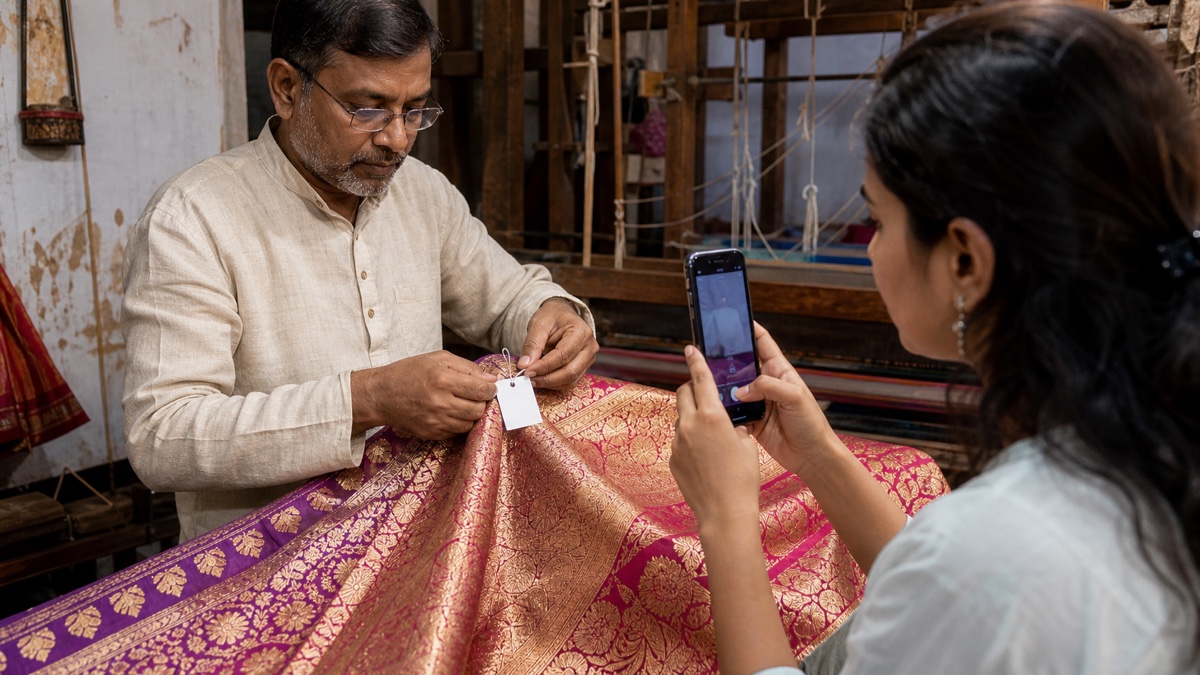
A group of Varanasi weavers has begun placing scannable labels on Banarasi saris through a mobile application called “Banaras Mein Buna,” an attempt to give customers a clearer record of who made a sari, what went into it and how it reached the shop counter. The initiative arrives amid a long-running complaint in the weaving community: power-loom products made elsewhere are sometimes sold to visitors as locally woven Banarasi pieces.
The app works through a barcode or QR label attached to a registered sari. A buyer can scan it with a phone to see details such as the manufacturing date, production method, fabric and thread, listed price and the name, address and telephone number of the maker or business responsible for the piece. That information is meant to make the transaction less dependent on a salesman’s description.
Shailesh Singh, associated with a weavers’ cooperative, said the codes are being issued to weavers and sari businesses rather than retail shopkeepers. According to his account, the system took about a month to develop, has reached roughly 20 to 30 per cent of participating outlets and has already been used in more than 1,000 purchases. Organisers hope to extend it across the city’s weaving network over the next month.
The central idea is traceability, not magic. A QR code can tell a shopper whether the digital record matches the sari in hand, but its value depends on careful enrolment and control of the labels. If a genuine tag is moved to another garment, the scanned description should still point to the original item, allowing an alert buyer to notice the mismatch. Administrators will nevertheless need audit checks, tamper-resistant labels and a way to report a wrongly described product.
Buyers should also understand what the app does not do. “Banarasi” is a protected geographical indication, and silk products may carry other recognised certification marks. A private or cooperative traceability entry can complement those protections, but it should not be presented as a government certificate unless the relevant authority says so. Material, weave, origin and price are separate questions, and a shopper may need to check more than one marker.
For weavers, the promise is more direct. When a customer can identify the person or unit behind a sari, the craftsperson becomes visible in a sale that might otherwise be credited only to the showroom. That record can help explain why a handwoven piece costs more than a mass-produced imitation and may make it harder to inflate the price of a cheap product by borrowing the Banaras name.
The app will earn trust only if the database remains accurate and accessible after the initial launch. Clear privacy rules are also needed because makers’ contact details are being displayed. Still, the experiment points towards a useful model: let every sari carry a verifiable account of its journey, and let customers judge the product with more information than a label and a sales pitch.
Sources and reporting
Based on an August 16 report and statements by Shailesh Singh of a Varanasi weavers’ cooperative. The QR system is a producer-led traceability initiative, not a substitute for statutory GI or Silk Mark certification.
Related Stories

Ramnagar Stages Barat and Ram–Sita Vivah on Day Six
FIR Over AI Video Claiming to Show Police at Lat Bhairav Event
Manchanda Case: SHO, ASI Face Departmental Action
Manduadih Fan Warehouse Fire Reignites After 48 Hours

Delhi Man Held in Golf Course Road Rage Case