
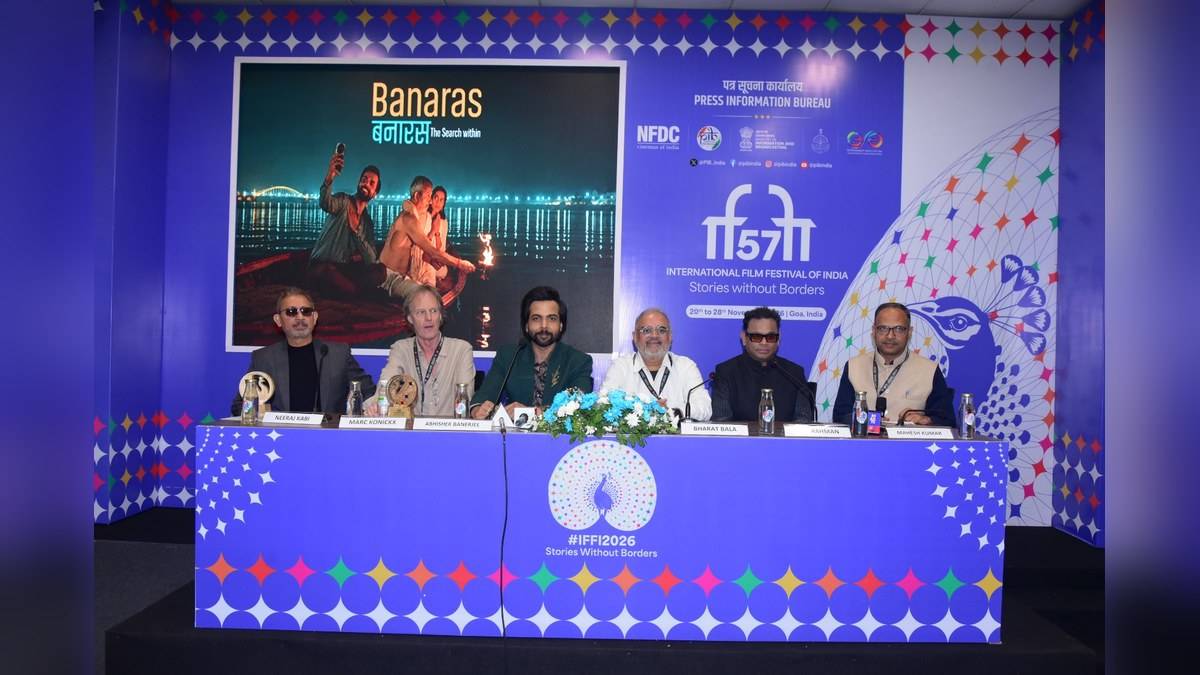
NEW DELHI: Banaras brings the city's musical inheritance to the Indian Panorama section of IFFI 2026 in Goa. The father and daughter drama reunites filmmaker Bharat Bala and composer A.R. Rahman. A PIB announcement dated November 22 confirms its India premiere at the festival, without announcing a Varanasi cinema release.
| Film | Banaras |
|---|---|
| Festival | 57th International Film Festival of India, Goa |
| Section | Indian Panorama feature films |
| Language | Hindi |
| Director | Bharatbala Ganapathy |
| Music | A.R. Rahman |
| Premiere status | India Premiere |
Banaras film 2026: what is the story?
The official IFFI catalogue, page 174, describes a family divided by patriarchy and the inheritance of a musical legacy. Its members journey along the Ganges seeking answers, with the Maha Kumbh Mela forming the culmination of that search. The premise places family relationships alongside questions about who carries an artistic tradition forward.
The catalogue identifies the film as an Indian production from 2026, in colour, and prints its duration as 100.42 minutes. That listing helps distinguish this Hindi film from other productions that share the name Banaras. Readers looking up its cast or songs should check the director and year as well as the title.
Banaras cast, crew and A.R. Rahman's music
Neeraj Kabi, Shahana Goswami and Abhishek Banerjee appear in the catalogue's cast listing. The production companies are BBP Studio Virtual Bharat Private Limited and Shiv Hans Pictures LLC. Ravinder Randhawa and Sriram Rajan receive screenplay credits; Marc Koninckx is director of photography and A Sreekar Prasad is editor. The director biography also lists Vande Mataram, Jana Gana Mana, Hari Om, Soulmates and Maryan.
According to the PIB account of the festival press conference, Rahman spoke about drawing inspiration from both Hindustani and Carnatic classical music. The release also highlights the use of the lesser used raga Dev Gandharva. His comments locate the score within a wider interest in India's musical and linguistic traditions.
PIB names Chhaya Kadam, Indira Tiwari and Antonythasan Jesuthasan among the additional cast. Kabi discussed playing a character with dementia, while Banerjee described the uncertainty of performing amid crowds at the Maha Kumbh. Koninckx spoke about using light, framing and colour to communicate emotion. These are the team's descriptions of its process, rather than a critical assessment of the finished film.
Why Varanasi's musical heritage matters to Banaras
The setting has a substantial musical identity beyond cinema. UNESCO's Creative Cities profile for Varanasi records its membership in the Music category since 2015. It describes cultural knowledge passing through festivals and fairs, and the role of the Guru Shishya Parampara, the traditional relationship between teacher and pupil, in sustaining musical practice.
That context offers a useful way into a story concerned with inheritance. Passing on music can involve teaching, repertoire and an enduring relationship between generations. A family drama about that inheritance therefore raises a different question from a travel portrait of the ghats: how does a living tradition find its next custodian?
UNESCO also sets out the city's ambitions for protecting musical knowledge through the Sangeet Sankul Music School, encouraging young talent and promoting exchanges between musicians. Its profile connects Subah e Banaras with music and inner wellbeing. These are elements of the city's cultural framework, rather than claims about scenes or characters in the film.
For more music related film coverage, read our Amar Singh Chamkila cast, songs and viewing guide.
The Ministry of Tourism's Incredible India guide to Varanasi similarly places music in everyday settings: temple courtyards, riverside gatherings, festivals and family traditions. It associates the city with shehnai musician Ustad Bismillah Khan, vocalist Girija Devi and sitar maestro Pandit Ravi Shankar. Those references help explain why musical memory is a meaningful starting point for a film bearing the city's name.
The guide also identifies Assi Ghat with the sunrise gathering of Subah e Banaras, bringing together music, yoga and devotion. Seen alongside the film's published premise, this background makes the riverbank more than a recognisable location. It is a place where public cultural life and private family experience can meet.
Where to watch Banaras: what does the IFFI listing confirm?
The announcement concerns a festival premiere. Readers planning to watch should distinguish that status from a general theatrical booking or an OTT listing. Neither a local showtime nor a streaming subscription follows automatically from selection in Indian Panorama. Check a dated screening or platform announcement before making viewing plans.
For related reading, our Qala music and cast guide covers another film connected with musical performance. Our report on Amish Katyayan Films' Chhath music video looks at a separate screen project rooted in regional culture.