Disclosure: Dalimss News CEO Maahir Madhok is an Additional Director of DALIMSS Sunbeam Group of Schools.
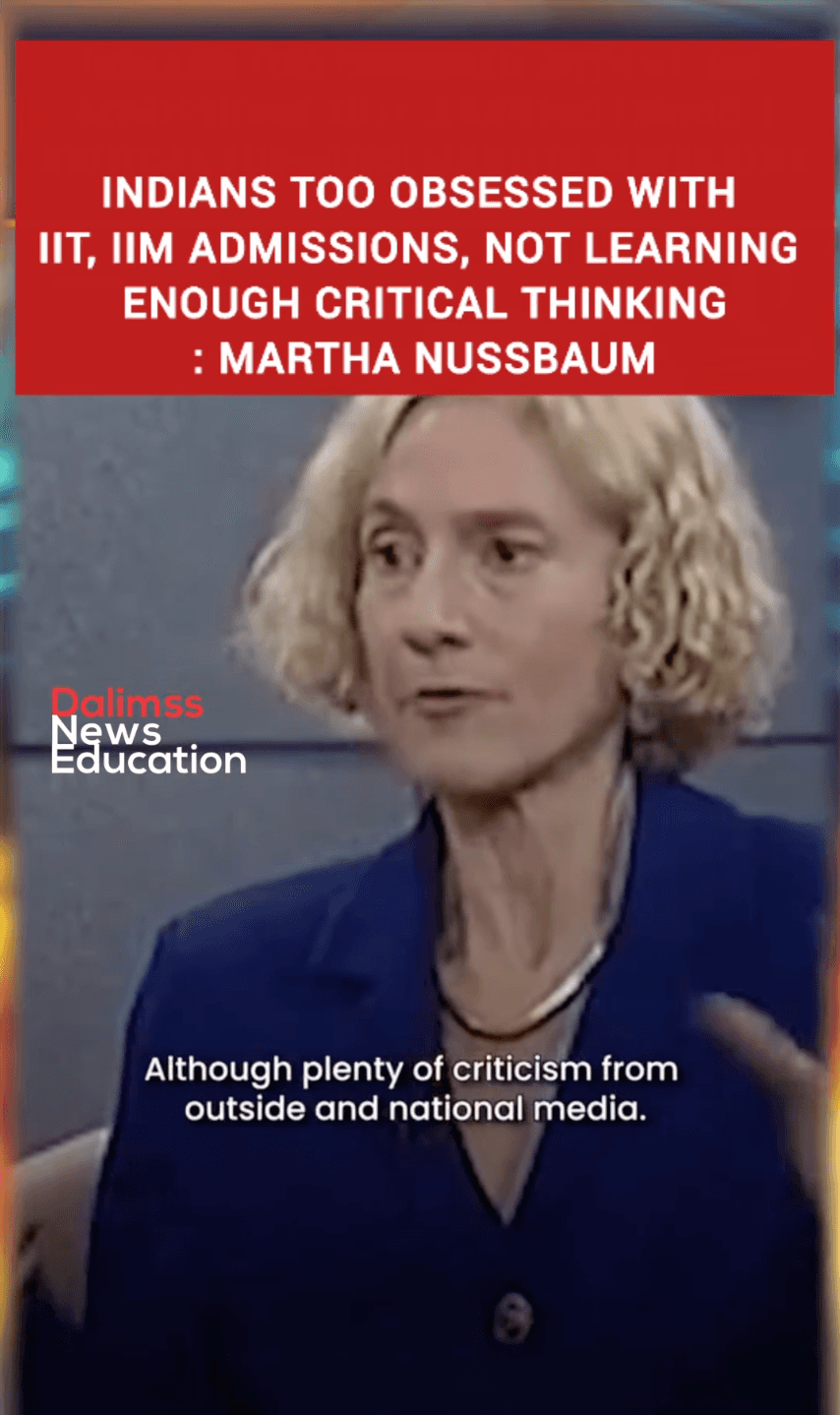
A recently viral video clip featuring renowned American philosopher Martha Nussbaum has sparked intense debate across social media platforms in India, reigniting the age-old conversation about the purpose of education versus the pressure of elite admissions.
In the clip, originating from University of California Television (UCTV), Professor Nussbaum offers a sharp critique of the Indian education system’s intense focus on securing seats in premier institutions like the Indian Institutes of Technology (IIT) and Indian Institutes of Management (IIM). She argues that this singular obsession often comes at a severe cost: the stifling of critical thinking, creativity, and independent thought among students.
Nussbaum, a Professor at the University of Chicago globally recognized for her influential work on ethics, justice, and the role of humanities in democracy, highlighted the immense societal and parental pressure placed on young minds.
"Parents will [find] their glory if their child gets into the Indian Institute of Technology and Management," Nussbaum states in the clip. She contrasts this with societal attitudes toward other fields, noting that many parents would feel "ashamed to have a child who's an artist or a writer or a humanist."
Her critique delves deeper than just parental expectations; it attacks the methodology used to achieve these elite admissions. Nussbaum warns that the current system often relies heavily on rote memorization, where students are "stuffed with all the things they need to pass these exams."
The consequence of this approach, she argues, is the production of graduates who, despite high test scores, have not been "taught to think for themselves." They may excel at replicating information but lack the necessary tools for independent inquiry, ethical reasoning, and creative problem-solving—skills crucial for navigating a complex modern world.
A Reflection for the Educational Community
Professor Nussbaum’s observations serve as a timely reminder for educators, parents, and policymakers nationwide. While the pursuit of academic excellence and professional security is understandable, her words urge a re-evaluation of what constitutes a "successful" education.
For educational institutions committed to holistic development, like DALIMSS Sunbeam, Nussbaum's critique reinforces the importance of balancing rigorous academic preparation with the nurture of the humanities, arts, and critical reasoning.
The viral clip suggests that a true education must go beyond merely passing exams; it must equip students with the intellectual independence to question, create, and carve their own unique paths in life, whether as engineers, artists, or humanists.