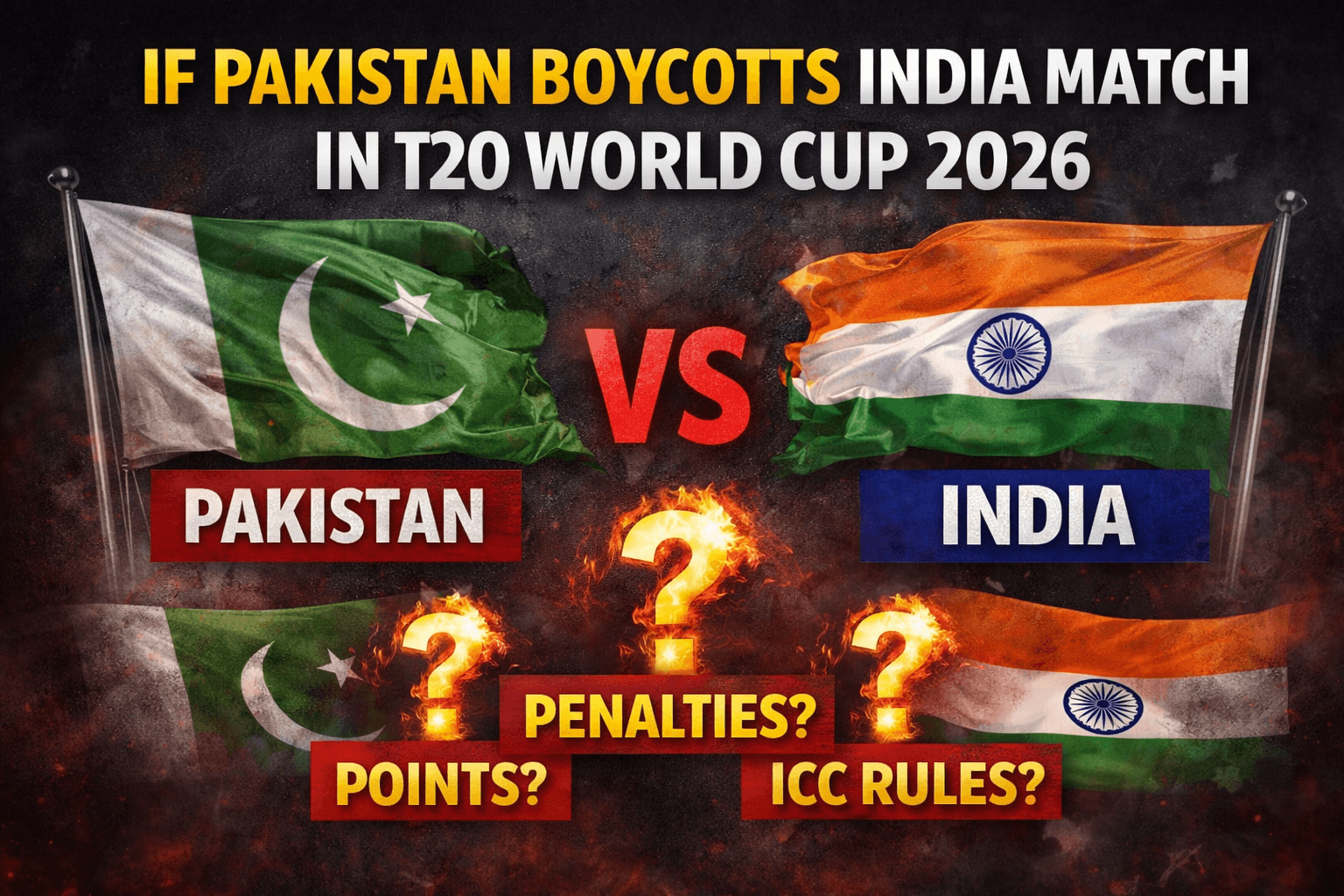
In a rare and controversial development ahead of the ICC Men’s T20 World Cup 2026, Pakistan has announced that it will boycott its scheduled group-stage match against India on February 15, 2026, despite confirming its participation in the tournament. The World Cup is co-hosted by India and Sri Lanka, with Pakistan’s group games to be played in Colombo.
Sporting Consequences
If Pakistan does not take the field against India, the match will be treated as a forfeit under ICC playing conditions:
India will be awarded two points for the fixture without any play taking place.
Pakistan will receive zero points, effectively losing ground in the group standings.
Pakistan’s net run rate will be negatively affected because, per ICC rules, the defaulting team’s full quota of overs is counted in calculating net run rate when a match is forfeited.
These sporting penalties could make it harder for Pakistan to qualify for the next stage, although arrangements such as pre-seeded Super Eight groups may affect the broader tournament implications.
Financial and Commercial Impact
The India vs Pakistan fixture is among the most commercially lucrative in cricket, generating massive broadcast, sponsorship, and advertising revenue worldwide. Analysts estimate that the cancellation of this match could lead to advertisement revenue losses of around ₹200–250 crore ($24–30 million) for broadcasters.
Because of this economic fallout:
The International Cricket Council (ICC) could withhold Pakistan’s share of annual revenue distribution — a significant source of funding for the Pakistan Cricket Board (PCB).
The PCB might also be required to compensate broadcasters and commercial partners for projected losses.
Possible ICC Sanctions and Broader Repercussions
Beyond immediate sporting penalties, ICC has warned of broader consequences if Pakistan proceeds with the boycott:
Financial penalties or disciplinary action under ICC rules.
Restrictions on player movement such as limiting No Objection Certificates (NOCs) for Pakistani players participating in foreign leagues like the Pakistan Super League (PSL).
Reputational damage and strained relations with other cricket boards, potentially affecting future bilateral or multilateral series.
ICC officials have stressed that selective participation undermines the spirit of global competition and could impact the long-term development of cricket in Pakistan and the broader international ecosystem.
Diplomatic and Sporting Context
India and Pakistan have not played a bilateral series since 2012 due to political tensions, which have frequently seeped into sporting relations. Decisions surrounding this boycott echo similar past instances in cricket where teams have declined fixtures over security or political stances.
The world now watches closely to see whether Pakistan will formally walk away at the coin toss on match day and how the ICC will balance regulatory action, commercial realities, and the political sensitivities surrounding cricket’s most-anticipated rivalry.